
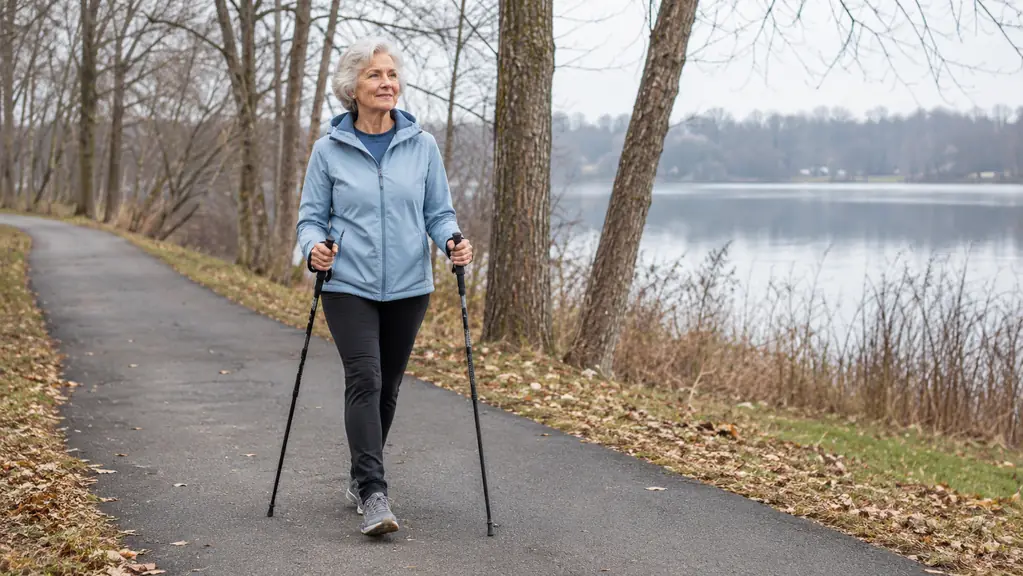
I bought the TrailBuddy trekking poles about five months ago, and I want to be honest about the reason. It was not because I had read something inspiring about hiking, and it was not because a doctor told me to. It was because the downhill stretch on the paved trail around the lake near my house had started to scare me. Going up was work. Coming down was a negotiation with my right knee, and I was losing that negotiation more often than I liked.
I am 61. I have mild to moderate osteoarthritis in both knees, the right one worse, and my doctor diagnosed it about three years ago. I used to walk four miles most mornings. Now a good day is two to three, and a bad day is the loop around the block. My physical therapist was the first person to suggest poles, and I ignored her for the better part of a year because I thought poles were for people climbing mountains. That was the first thing I was wrong about. This is the review I wish someone had handed me, including the parts the product page does not mention and the parts I had to learn the hard way on the shoulder of a trail.
The Quick Verdict
Useful on the downhill and in winter, and honest about what it is not. Give yourself three walks to get the height and the strap right, or you will blame the poles for your shoulders.
Amazon Check Today's Price →The downhill side of the walk is the part these are actually for.
Two 7075 aluminum poles, 9.7 ounces each, lever locks I can work with one hand, and a range from 24.5 inches collapsed to 54 inches extended. Five months in, mine live in the hall closet and come out on every long walk.
Amazon Check Today's Price on Amazon →How I Actually Use Them
Here is the unglamorous truth about how these get used in real life, which is nothing like the product photos. I use them on the lake trail. I use them on icy sidewalks in January. I use them on long errand days where I know I will be standing in a line and then walking to the far end of a parking lot. I do not use them to climb anything, because there are no mountains in Bloomington, Minnesota. What I use them for is keeping a walk that I was about to give up on.
Setup took about ten minutes the first time, and most of that was me being careful rather than the poles being difficult. They slide out of the carry bag, you extend them, you close the lever. Each pole weighs 9.7 ounces, and the pair with the bag is listed at 1.2 pounds. That number matters more than it sounds like it should. A heavy pole is a pole you leave in the closet, and I have done that with other things.
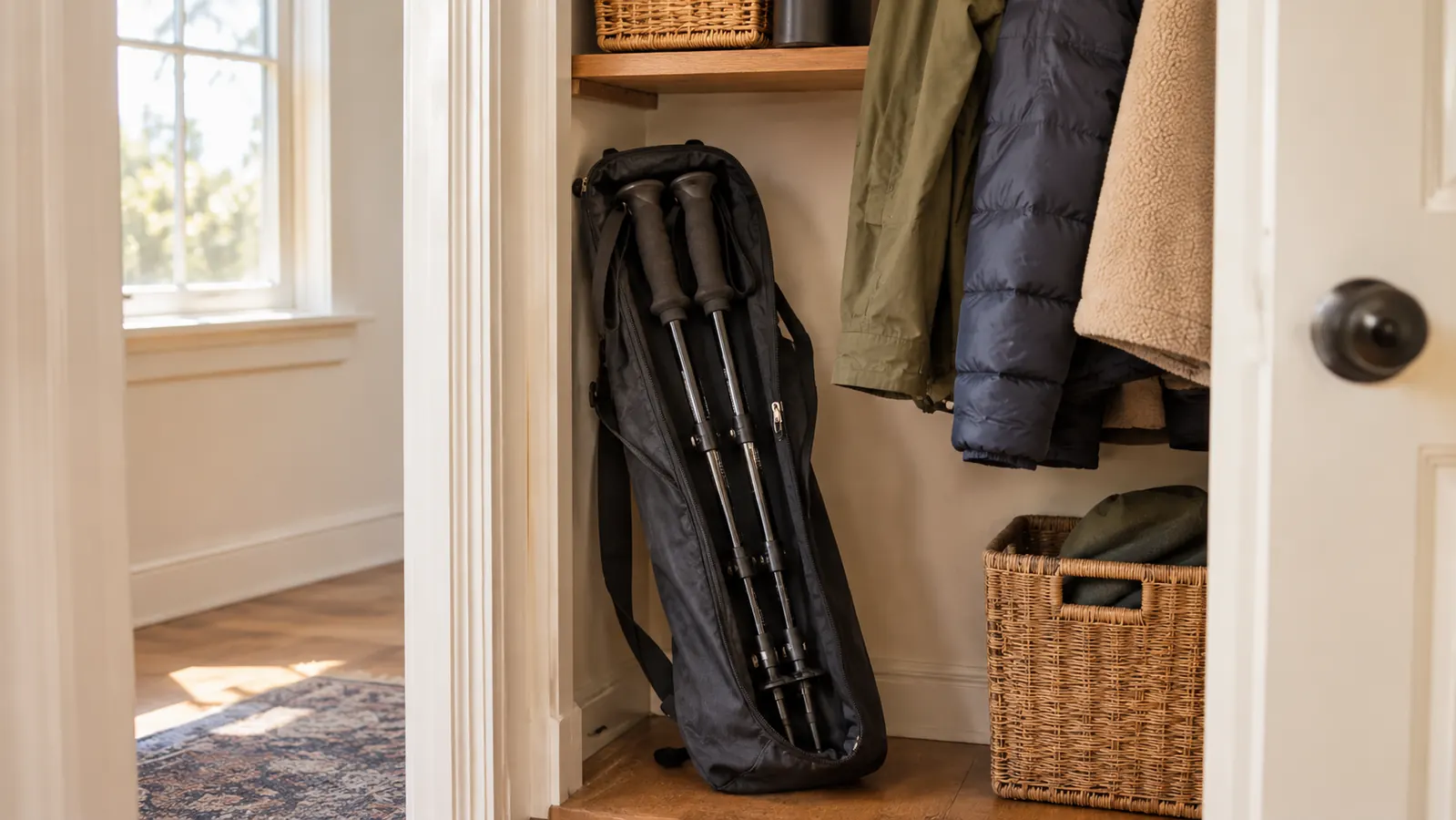
They collapse to 24.5 inches and extend to 54. Fully collapsed, both poles go into the carry bag and the bag goes on the shelf in the hall closet next to the vacuum. That is where they live when they are not in my hands, and I want to be clear that they spend real time there. On a short dry loop, the poles stay home. On anything long, anything wet, anything with ice on it, they come with me.
The other thing I did not expect is how quickly they became a habit rather than a decision. For the first couple of weeks I had to remember them. Now I check the weather and know, before I put my shoes on, whether it is a pole day. That is not a dramatic change in my life. It is just the difference between a walk I finish comfortably and a walk I cut short at the halfway point.
My first walk with them was a two mile loop and I felt ridiculous for the first half mile. That feeling goes away faster than you would think, mostly because you stop noticing the poles and start noticing that you are not bracing quite so hard on the downhill. By the second week I had stopped caring what anyone on the trail thought, which is a benefit nobody puts on a box.
What Nobody Tells You About Fit
The biggest thing I had to learn, and nobody at the trailhead mentioned it: the pole should not be set to your height. With the tip on the ground, the handle should come up to roughly your hip when you are standing on level ground. Mine are set there for flat walking. For the downhill stretch, which is the entire reason I bought them, I shorten both poles by a couple of inches so I am not reaching forward with every step. Getting that wrong made my shoulders tired for a week before I worked out what I had done.
There is a simple way to check the setting without a helper. Stand the pole upright with the tip on the ground and the handle under your arm. If the handle lands in your armpit, you are in the right neighborhood for flat ground. I tried that, found it matched where my hip had been telling me to set them, and stopped guessing. Most of the time, though, you just notice after a mile whether your shoulders are aching, and adjust from there.
The lever locks are the part I did not expect to care about. They open and close with one hand, which sounds like a small convenience until you are standing on the uneven shoulder of a road, holding a pole in each hand, and trying to adjust one while someone walks past you. I have not had to re-tighten them once in five months, in warm weather or cold.
The poles are listed as standard, all heights, and the range from 24.5 to 54 inches means there is a lot of adjustment in both directions. I have room left at both ends of mine. Gary is taller, borrowed them once, extended them, and handed them back without a complaint, which from him is a strong review.
The Grips and the Straps, Which I Got Wrong First
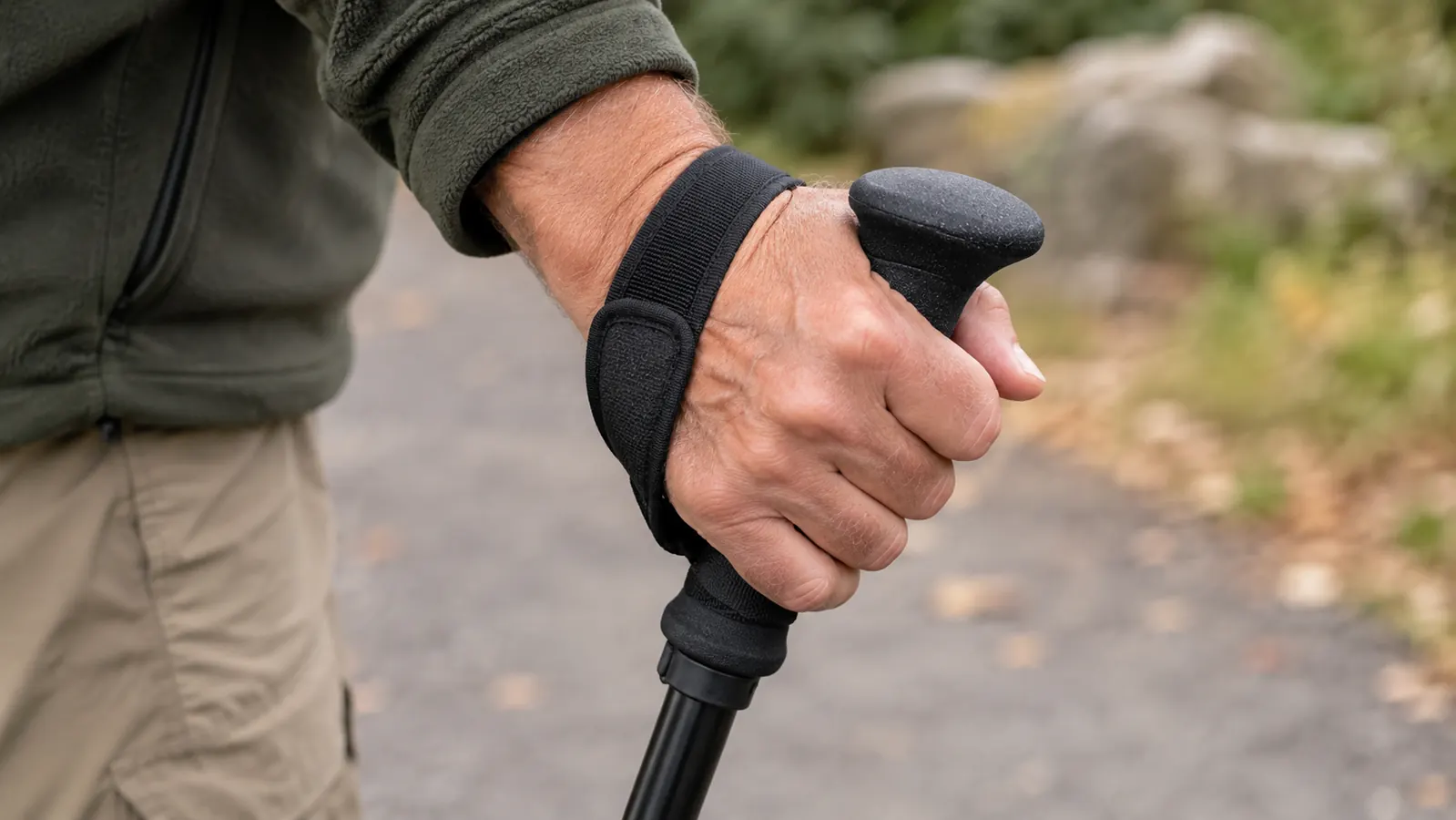
For the first two weeks I held the handles the way you hold a railing in a windstorm, and my forearms ached for it. Then I understood what the padded straps are actually for. You come up through the strap from underneath, so the strap takes your weight through the wrist and your fingers can relax. Once I did that, the ache went away and my hands stopped cramping on longer walks. That single change was worth more than any adjustment to the poles themselves.
The handles are plain and they have been fine. No blisters, no slipping when my hands get warm, nothing that made me want to wrap them in anything. In cold weather I wear a thin glove and the strap still sits where it should. It took me a few walks to find the spot where the strap did not pinch the back of my hand, and I got there by paying attention rather than by fiddling with hardware.
The tips are threaded, which sounds like a minor engineering detail until you have lost a basket in mud. Mine have stayed on through slush and through a wet October, and the rubber tips stay put on pavement. I keep the rubber tips on for the lake trail and put the snow baskets on in the winter, and swapping them takes less time than finding my gloves.
I go out on days I would have stayed in, and staying in is how a walking habit quietly dies.
What These Poles Do Not Do
This is the part I wish someone had said plainly to me. The TrailBuddy poles do not take the load off your knee. They share some of it. On a downhill stretch I can feel the difference in how hard my right knee works to slow me down, and that difference is real and it is why I keep using them. But I still feel my knees at the end of three miles. The poles make the walk possible. They do not make it free.
They also do not replace the rest of what I do. I still wear a compression knee sleeve on the right knee for morning walks. I still ice for fifteen or twenty minutes after a longer day. I still use the gel my doctor approved, as the label directs, on the days that ache. The poles are one piece of a routine, not the routine. If you buy them expecting to put everything else down, you will be disappointed inside a week, and the poles will end up in a closet.
And they are not hands free. There is no version of walking into a shop with two poles and a basket where I feel graceful. On errand days I collapse them and carry them, or I leave them at home and lean on the cart instead. That is not a flaw in the poles. It is a fact about walking with poles, and the photos do not show it.
Your hands do some work too. Even with the strap carrying your weight, three miles of poles is three miles of holding onto something. If your grip is weak or your hands complain in cold weather, try a short loop first before you commit to a long walk with them. That advice costs nothing and I wish I had taken it on day one instead of day four.
Winter, Concrete, and the Walks I Used to Skip
I bought them in spring, and by January they had earned their keep twice over. Icy sidewalk, slush at the curb, the packed snow at the edge of the lake path. Snow baskets on, gloves on, out the door. Since I started using the poles in winter I go out on days I would have stayed in, and staying in is how a habit quietly dies. That is the sentence I would put on the box if anyone asked me.
One thing about pavement. The rubber tips are quiet, and I leave them on for the lake trail. On bare concrete the poles make a clicking sound that I find oddly satisfying and that Gary finds unbearable, so the rubber tips stay on when we walk together. That is the level of problem these poles cause, which is to say not much.
The place they help least is inside. I tried them on the treadmill in the basement exactly once. They clattered, there was nothing to brace against, and the belt kept moving while I was trying to think about my feet. If your winter walking happens indoors, these will do nothing for you. That is an honest limit and not a knock on the product.
Flat concrete is the other place I notice them least. On the long level stretch of pavement the poles are mostly along for the ride, and I could leave them home without missing much. It is the downhills and the uneven ground, the roots and the frozen ruts, where they earn their place. If your walks are short, flat and smooth, I would rather tell you that than sell you something that will sit by the door.
A Few Small Surprises
The weight is the first one. 9.7 ounces a pole does not sound like anything on a product page, but I had tried a heavier pair once and felt the difference by the halfway point. Over two or three miles, that is the difference between carrying poles and dragging them behind you.
The TrailBuddy carry bag does exactly one job well, which is keeping both poles together in the closet. It is not a padded travel case and it is not something I would want on my shoulder for a day out. It does the job I need it to do, which is sitting on a shelf in the hall closet with both poles inside it.
The baskets are the other small thing. I expected to lose one in the first month. I have not, because they thread on rather than push on, and that is the whole reason. Two mud baskets and two snow baskets came in the box, and both pairs are still accounted for.
The warranty is five years limited, covering defects. I have not needed it, and I mention it because five years is longer than most things in this house last, and because it tells you the company expects the poles to still be around in year five.
What I Liked
- Lever locks open and close with one hand, no fumbling on a cold trail
- 9.7 ounces per pole, light enough that they come along instead of staying in the closet
- Adjusts from 24.5 to 54 inches, so there is room to set them short for downhill stretches
- Threaded tips hold the baskets on through mud and slush
- Collapses into the included carry bag and fits on a closet shelf
- Five year limited warranty on defects
Where It Falls Short
- No help at all indoors or on a treadmill
- Fit takes two or three walks to work out, and set wrong they tire your shoulders
- Still a two-hand item on errands, and not hands free
- They share knee load rather than remove it, so a long day still aches
Who This Is For
This is for the person whose walking has quietly shrunk. If four miles used to be normal and now two is a good day, and the downhill is the reason, these are worth a try. If a knee has started talking to you on stairs and long walks, and your doctor or physical therapist has said light support is reasonable, poles are a low stakes thing to test before you give the walk up entirely. They are also for anyone who walks through a real winter, because that is where mine have paid for themselves many times over. The TrailBuddy set is not the only pair on the market, but it is the pair I have used for five months and the one I can speak to honestly.
Who Should Skip It
Skip them if your walks are short, flat and on smooth pavement. Skip them if you want something that folds into a coat pocket, because 24.5 inches collapsed is compact but it is not pocket sized. Skip them if you are not willing to spend two or three walks getting the height and the straps right, because set wrong they will make your shoulders tired and you will decide the poles are the problem. And skip them if you are expecting the knee pain to go away. It will not. You will just be able to keep walking, and for me that turned out to be the whole point.
Five months in, they still come out of the closet on every long walk.
If the downhill stretch is the part that scares you, that is exactly what these are for. Set them a little short, use the straps, and give yourself three walks before you judge them.
Amazon Check Today's Price on Amazon →