
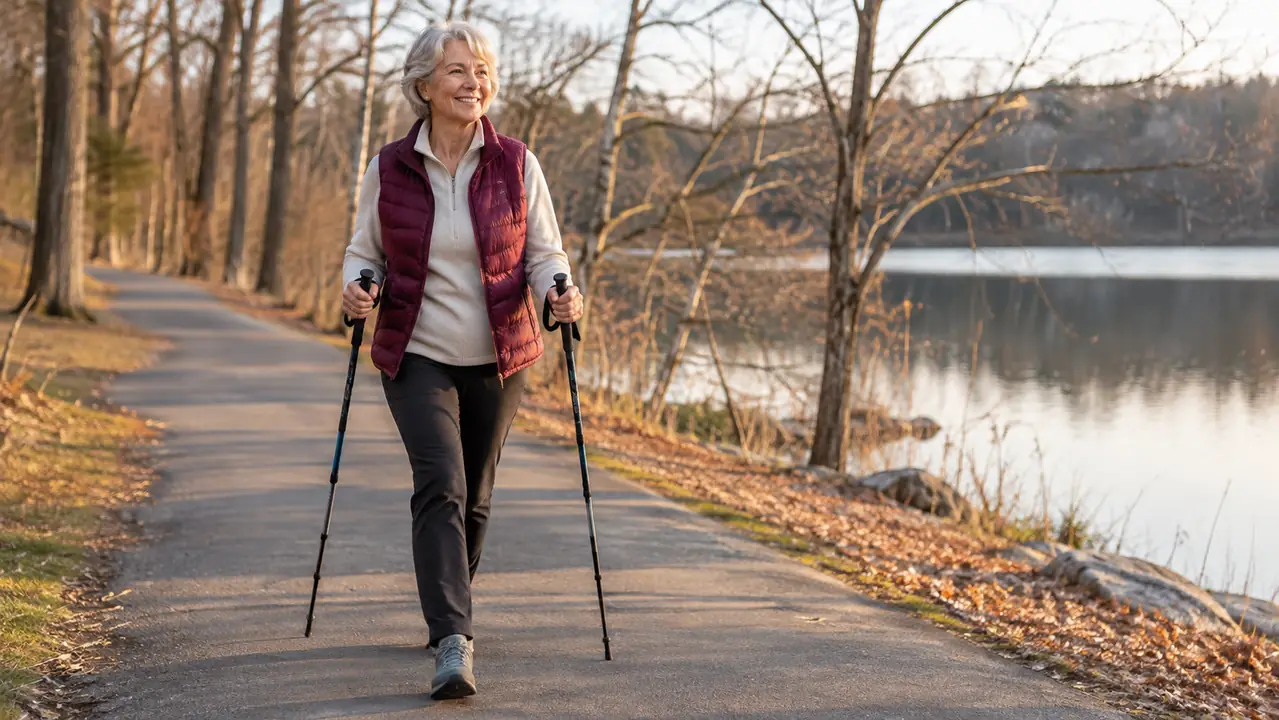
I bought my TrailBuddy trekking poles in late fall for one stretch of trail: the quarter mile of downhill between the far side of the lake and the parking lot. My right knee had been filing complaints about that stretch for a year. My left knee was quieter about it, but it was not happy either.
So this is not a survey of every pole on the market. It is a straight comparison between the TrailBuddy pair I have walked with for about five months and the TheFitLife pair I handled and walked with for a single morning, plus what I could read on both product listings with my reading glasses on. I also asked my walking partner what she paid attention to when she bought hers, and her answer was the grip, which would not have occurred to me. I am 61, I have mild to moderate osteoarthritis in both knees, the right worse than the left, and I walk two to three miles most mornings on pavement. That is the whole of my expertise. It is also the lens this comparison comes through.
The short answer: if you want lever locks you can flip with one hand and a warranty long enough that you will forget you have it, TrailBuddy. If you want the bigger box of spare tips and baskets, and a grip shape some walkers find easier on a long day, TheFitLife. Neither pair fixes a knee. Both take load off the downhill, which is the actual job.
| TrailBuddy | TheFitLife | |
|---|---|---|
| Lock type | Lever locks you flip with one thumb, one hand, even with a glove on | Flip locks as well, though the pair I handled needed two hands to get properly tight |
| Height range | 24.5 inches collapsed, 54 inches at full extension | A similar range for most adults, though I did not put a tape measure to it |
| Weight | 1.2 pounds for the pair, about 9.7 ounces per pole | Aluminum poles of similar weight; in my hands the difference was not something I could feel |
| Warranty | Five year limited warranty covering defects | I could not find a comparable term on the listing I read |
| Accessories in the box | Mud baskets, snow baskets, a carry bag, and threaded tips that hold the baskets on | A larger kit, with more spare tips and basket options than most walkers will ever use |
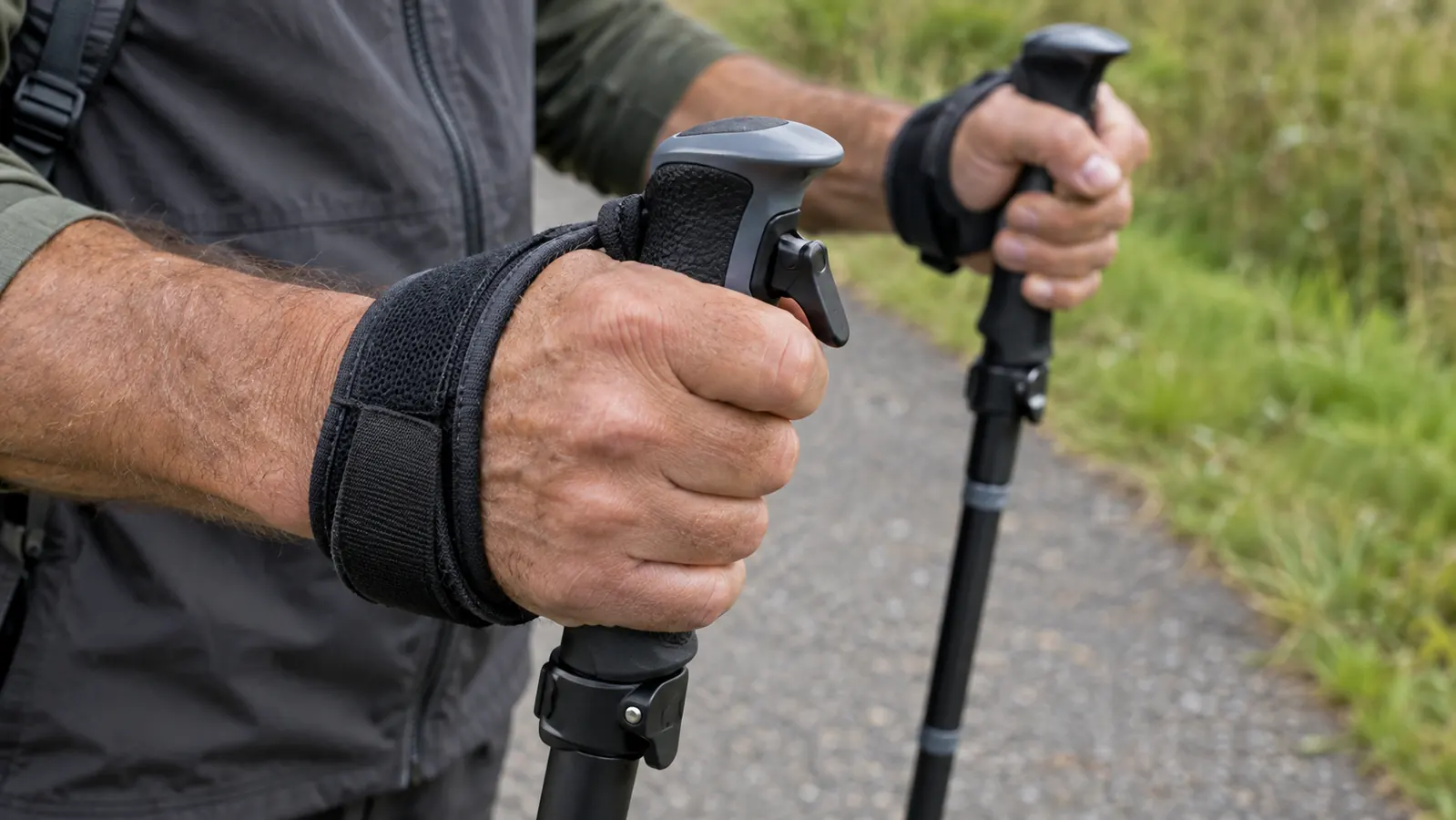
| Handle and strap | Padded straps that took me a few walks to adjust correctly | A contoured grip that left my palm less cramped after one loop |
| Packed size | Collapses to 24.5 inches, short enough to sit behind a car seat | Collapses in sections too, though the pair I saw packed a little longer |
| Best for | Everyday walkers who want a one-hand lock and a long warranty | Walkers who swap tips often and prefer a shaped grip |
What I Compared, and How I Compared It
I did not run a lab test. I walked. Five months of mornings on the same paved loop around the lake, two to three miles at a time, both poles on the longer days and no poles at all on the short ones. The downhill stretch is where I pay attention, because that is where my right knee decides how the rest of my day is going to go.
I set the poles a little shorter going downhill, the way I was taught, and I use both of them rather than one. I tried a single pole first, back in October, thinking it would be less fuss. It was less fuss, and it also pulled me off balance toward the pole side, so I went back to two. Two poles means both arms swing, both shoulders carry a share, and my right knee is not quietly doing the work of everything. On the flat I barely think about them, which is the entire point. If I am noticing the poles, something about the setup is wrong, usually the height or the strap.
The TheFitLife pair belongs to a woman I walk with some mornings. She handed them over for one full loop and let me play with the locks at the trailhead, and I have since read the listing the way I read every listing, slowly. One morning does not make me an authority on anything. Where I am unsure, I say so, in the table and in the paragraphs below.
Where TrailBuddy Wins
The lever lock is the thing I notice every single time. I can flip it open and closed with my thumb while my other hand is holding a glove or a water bottle. One morning in January the temperature was in the teens and I had thick gloves on. I flipped both locks open with my thumbs, set the poles shorter for the hill, and closed them again without taking a glove off. The two-handed twist locks on an old pair I gave up on years ago would have meant stopping, pulling a glove off with my teeth, and doing the whole thing twice.
The second thing is that the accessories stay where I put them. The tips are threaded, so the baskets hold on in mud and snow instead of pulling off somewhere in the middle of the trail. I have lost a basket to that exact problem before, in a slushy March, and I did not notice until I was a mile from the car.
The third is that nothing has loosened in five months. The sections still lock at the height I set them the first week, and I have never had one slip under my weight on a downhill. They weigh 1.2 pounds for the pair, about 9.7 ounces per pole, which is light enough that on flat pavement I forget I am carrying anything at all.
The carry bag is a small thing that turned out to matter. Two poles strapped together and hung on a hook in the hall closet means they are where I expect them, not leaning in a corner behind a door where I will knock them over on the way to the kitchen. Small thing. Five months of small things.
The five year limited warranty covering defects is not something I expect to use. It is something I notice, because a company does not put a number like that on paper unless it expects the poles to still be around in year four.
Where TheFitLife Wins
The accessory kit is bigger. From what I could see in the box my walking partner carried and on the listing, TheFitLife gives you more spare tips and more basket options than most walkers will ever swap in. If you hike mixed terrain and you genuinely change tips between seasons, that is worth something real. I have never swapped a tip mid-season in my life, so for me that box would be mostly weight in the closet.
The grip shape is the other honest point. Their handle is contoured, and on the one loop I did my palm felt less cramped at the end than it does with the padded strap on mine. It took me three or four walks to get the TrailBuddy strap adjusted properly, and until I did, my hand was working harder than it needed to. Fine after adjustment is not the same as right out of the box.
Here is the part that will not help anyone sell anything. For most everyday walkers the two sets are close. If the TheFitLife pair is the one that fits your height and feels right in your hand, you are not making a mistake, and you are not giving up something that would show up on a two mile walk around a lake.
The one-hand lock is why I stopped borrowing poles and bought my own
Lever locks you can flip with a thumb, 24.5 to 54 inches, 1.2 pounds for the pair, and a five year limited warranty. Mine live in the hall closet and come out most mornings.
Amazon Check Today's Price on Amazon →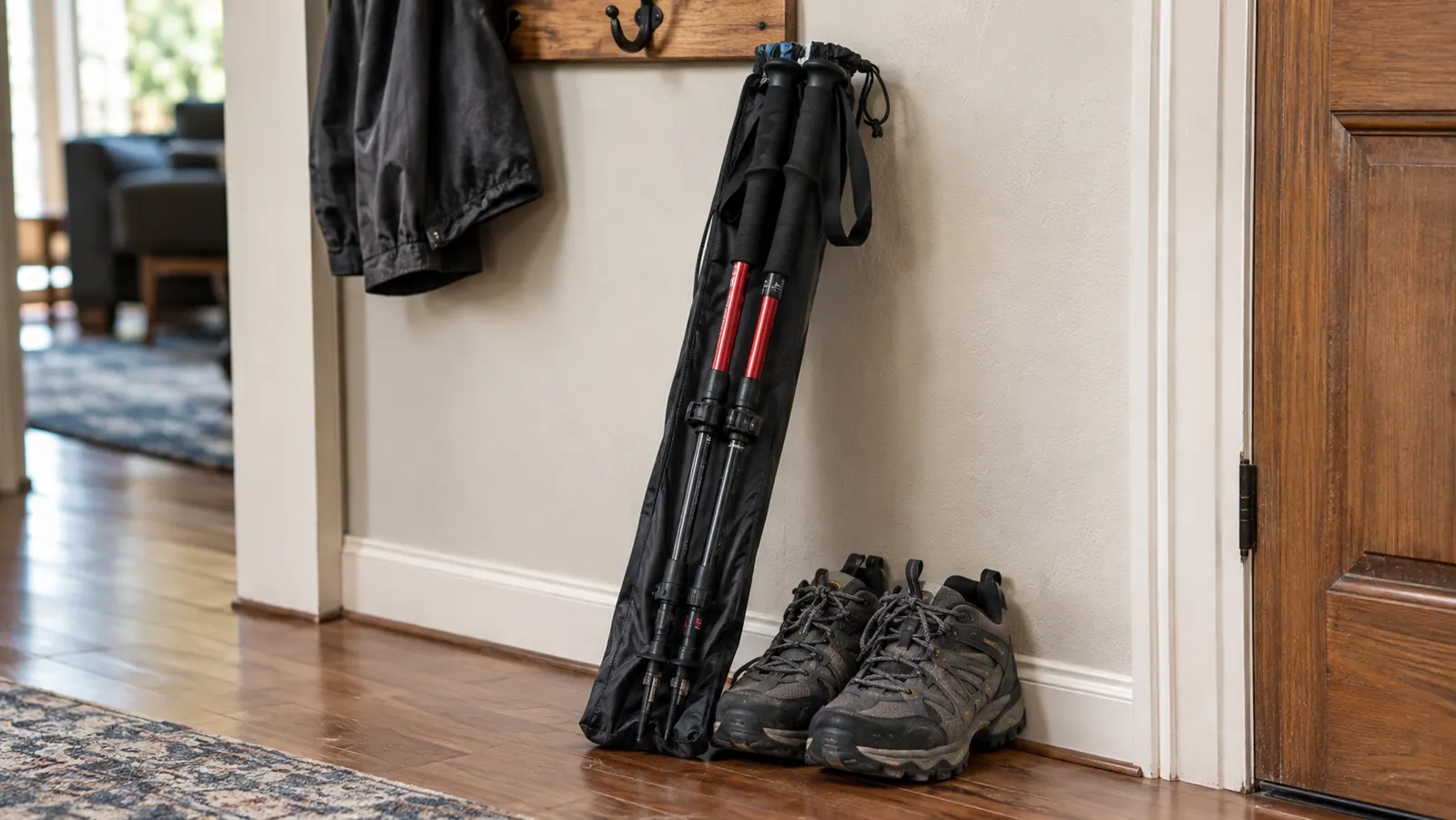
What Five Months of Mornings Actually Changed
Before the poles, I had quietly shortened my loop. Two miles instead of three on the days my knee was loud, and I told myself that was fine. It was not fine, it was just easier than admitting the walk was shrinking. The poles did not give me back four miles. They gave me back the far side of the lake, which is the pretty half.
The first week was clumsy. Two poles means your arms are doing something they have not done since cross country skiing in high school, and I felt it in my triceps before I felt anything in my knees. By the third week I stopped thinking about where to plant them. By the fifth week I noticed I was walking the downhill at a normal speed instead of a careful shuffle.
I do not use them for everything. A short walk to the mailbox, no. A quick loop when I am running late, no. Longer mornings, the icy weeks, and any day I plan to be on my feet for hours, yes. There was a Saturday in April when I walked with a friend who does not use poles at all. I carried mine collapsed for the first mile and a half, then pulled them out at the top of the hill and used them the rest of the way. That is the sort of thing the lever locks make easy, and it is not a small convenience when your hands are cold. They live collapsed in the carry bag in the hall closet, and at 24.5 inches collapsed they fit behind the seat in the car without a fight.
Five months, two to three miles a morning, and the sections still lock at the height I set them the first week.
The Downhill Stretch, and the Ice
The downhill is why I bought poles in the first place. Going up is work, but going down is the part that used to take the next day out of me. With both poles planted ahead of me and my steps shortened, that quarter mile stops being the piece I dread. It is still a hill. It is just a hill I get down without thinking about my right knee the entire way.
Winter is the other reason. Bloomington sidewalks get icy in a way that turns a two mile walk into a decision rather than a habit. Last February I counted the days I skipped the walk entirely. Four. The winter before, I could not have given you a number, because at one point it was closer to three weeks in a row. The snow baskets went on in November and stayed on until the sidewalks cleared in March. On the worst weeks I take it to the mall or to the treadmill in the basement and the poles stay in the closet, which is fine.
What the poles do not do is fix anything. They do not replace the compression sleeve I wear on my right knee, the ice pack after a long day, or the eight weeks I spent with a physical therapist. They are one more thing that keeps me walking. I run all of it past my doctor rather than deciding on my own, and I would tell anyone with knee pain to do the same.
Who Should Buy Which
Buy the TrailBuddy if you want a pole you set once and then forget about. If you walk alone, if you need to adjust with one hand while the other hand holds something, and if you like knowing the baskets will still be attached at the end of a muddy mile, that is this pair. It is my situation, and it is why the poles in my hall closet say TrailBuddy on them.
Buy the TheFitLife if you change tips often, if you walk terrain where the different baskets actually get used, or if the contoured grip simply feels better in your hand at the store. That is a real reason to pick a pole. Hands are not interchangeable and neither are knees.
Either way, get the height right before you judge anything. Stand up straight, set the pole so your elbow sits at about a right angle with the tip on the ground, and shorten it for downhill. It took me three walks to land on a height I did not have to think about, and I wrapped a strip of tape around the section so I could find it again after the poles had been collapsed for a car trip. A good pole at the wrong height feels exactly like a bad pole, and most of the people I hear complaining about theirs never changed the setting.
And if neither of these appeals, that is worth saying too. If you only walk twenty minutes on flat pavement and your knee is quiet, you may not need poles at all, and a pair sitting in a closet is not helping you. I bought mine because of one hill and one icy season. That is a specific problem, and it has a specific answer. If you are not sure, borrow a pair for one loop the way I did before you spend anything.
Start with the downhill stretch. That is where you will know.
Five months in, the TrailBuddy poles are the reason the last quarter mile home is not the part I dread. Two poles, a carry bag, baskets for mud and snow, and a five year limited warranty.
Amazon Check Today's Price on Amazon →