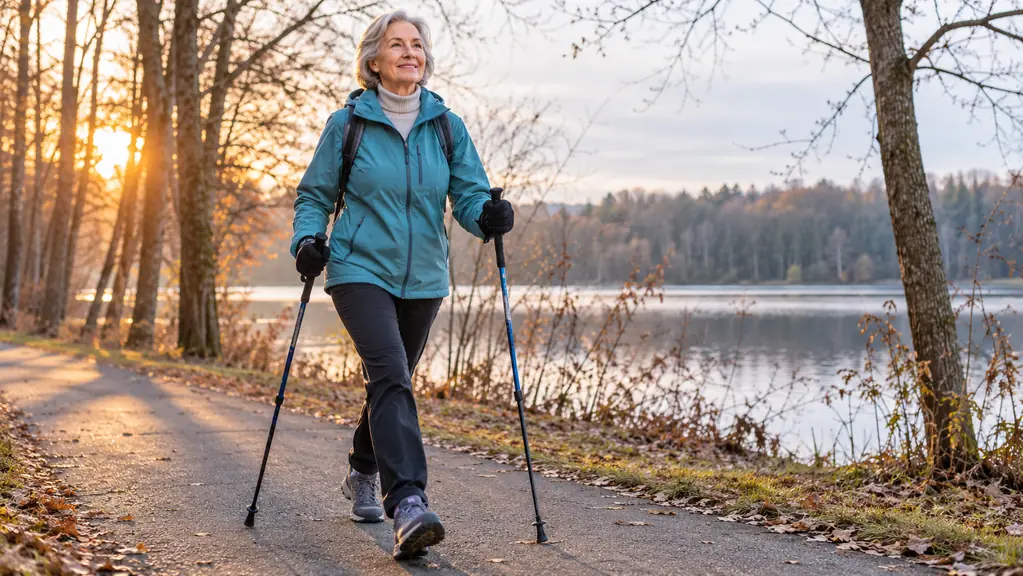
The downhill side of the lake loop is where my knees used to call the walk over. It is maybe a third of a mile of gentle slope, nothing anyone would call a hill, and by the bottom my right knee had that hot, tight feeling that told me I would be sitting with an ice pack that afternoon instead of getting on with my day. I am 61. I have osteoarthritis in both knees, the right one worse than the left, diagnosed about three years ago. About five months ago I bought a pair of TrailBuddy trekking poles for that stretch and for the icy sidewalks between January and March here in Bloomington. Not because I believed a pair of poles would fix my knees. Because I wanted to reach the bottom of that slope still enjoying the morning instead of already thinking about the freezer.
I have walked with them most mornings since. Paved trail around the lake, sidewalk errands, and the treadmill in the basement when the weather is bad enough that even the mall feels like too much effort. That is five months of ordinary use, not a weekend test, and long enough that the newness has worn off and I can tell you honestly what changed and what did not. The short version: nothing I own touches the arthritis itself, and I am not going to pretend otherwise. What the TrailBuddy poles did was move some of the load off the downhill and give me something solid to hold on ice. That turned out to be enough to keep me walking the full loop instead of cutting it short at the bench.
The Quick Verdict
Two light aluminum poles with one-handed lever locks that made the downhill stretch of my lake loop feel manageable again. Not a fix for arthritis, and the straps took me two months to stop fighting, but five months in they still come out of the hall closet most mornings.
Amazon Check Today's Price →The downhill stopped ruining my mornings. Here is the pair that did it.
Two 7075 aluminum poles at 9.7 ounces each, lever locks you can work with one gloved hand, and a 24.5 to 54 inch range that fits me and my taller husband. Backed by a 5 year limited warranty.
Amazon Check Today's Price on Amazon →How I've Used It
I walk most mornings, usually the paved trail around a lake near my house. Before my knees flared I did about four miles. Now it is two to three on a good day, and my loop has one real downhill and a long flat run along the water. That shape of walk is exactly why poles made sense to me and a new pair of shoes alone did not. I use both poles on the longer loop. For the ten minute walk down to the mailbox and back I leave them home, because there is no slope on that route and carrying them is more effort than it is worth.
Setup took one walk to sort out. The poles are marked for height, the lever locks flip open and press shut, and I run them a little shorter for the downhill side, which is the one adjustment that made an obvious difference. When I first started I had them too long and felt it across my shoulders by the halfway point. Shorter going down, a touch longer on the flat, is what works for me. My husband Gary, who is taller than I am, had his set where he wanted them in about a minute, and he is not a man who reads instructions.
There is a second thing I got wrong at the start and it cost me more than the height did. I measured for the poles standing on the living room rug in my stocking feet, worked out a number, and set both to it before the first walk. That number was too long by a good inch and a half, and I spent three walks wondering why my wrists ached. What actually worked was setting them on the sidewalk in my walking shoes, planting the tip a step ahead of me, and checking that my elbow sat at a right angle with my hand on the grip. Ten seconds of doing it on the pavement beat the arithmetic I did in the house.
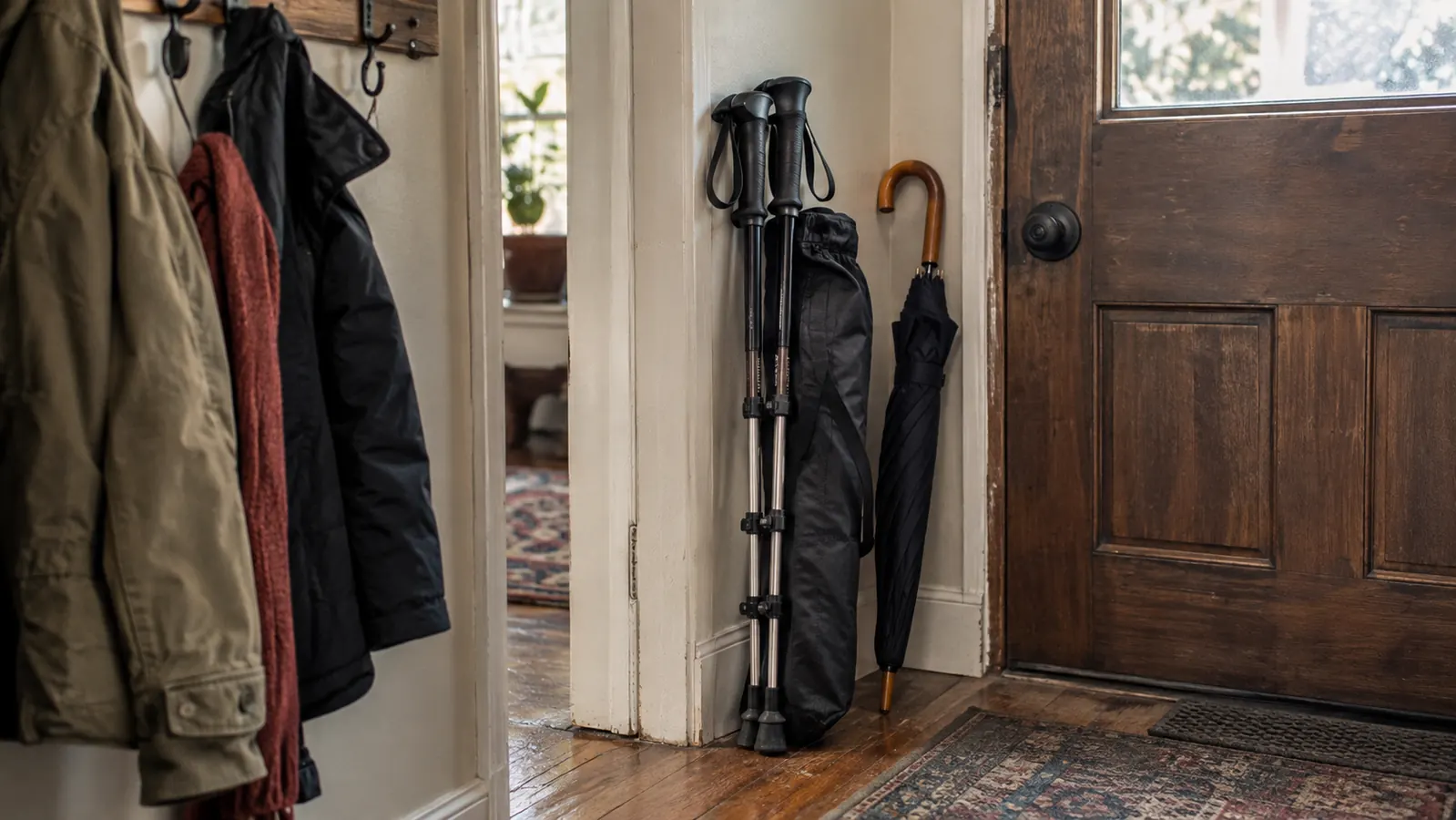
Where they live is the hall closet, collapsed in the carry bag next to the umbrella. Not because I am precious about them. Because that is the door I leave from, and if a thing is not by the door I will not carry it. Five months in, the bag has a scuff on one corner and the poles look about the same as the day they arrived.
The Lever Locks Are the Reason I Kept Them
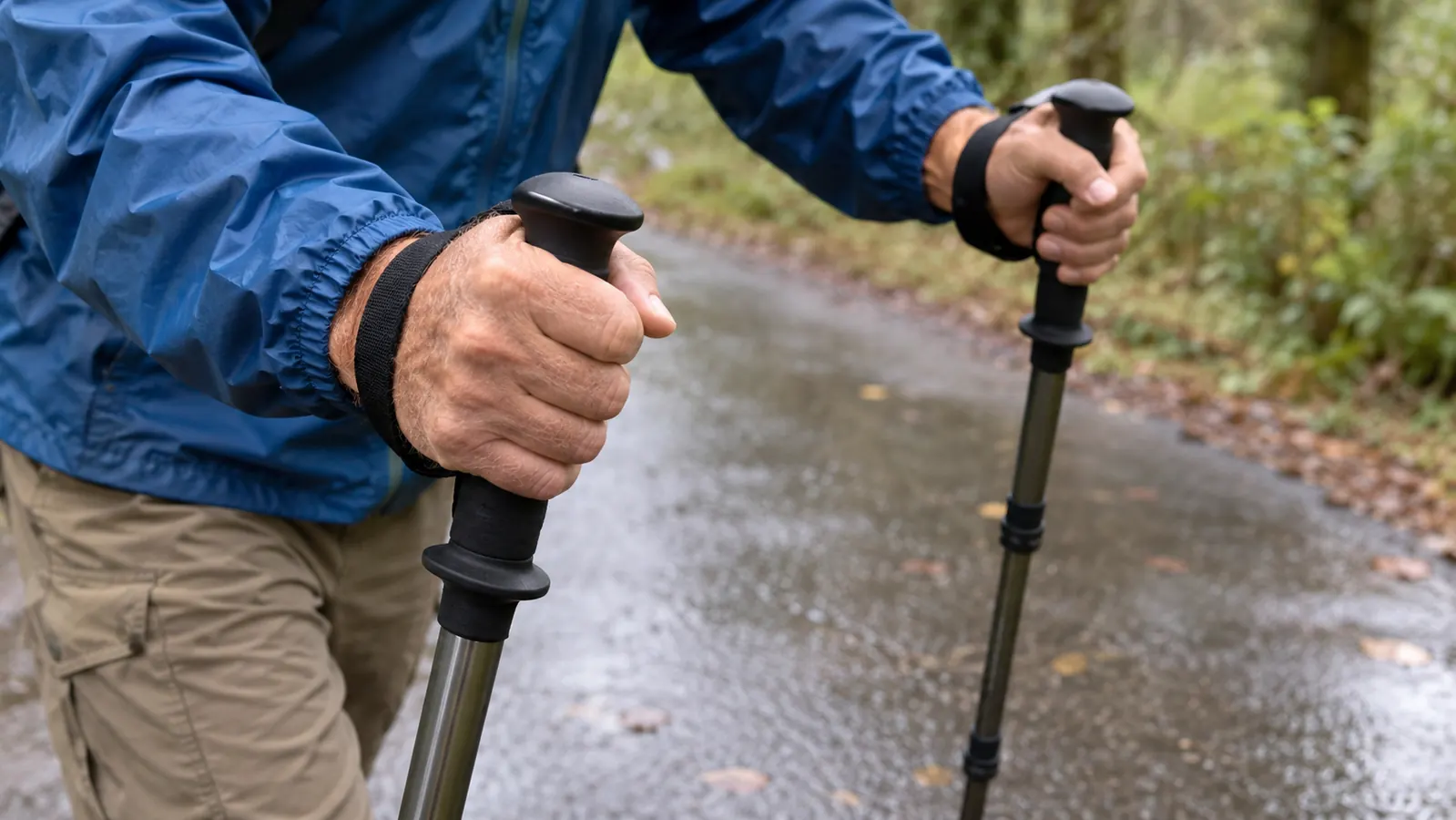
The TrailBuddy poles use lever locks. You flip the clamp open with a thumb, slide the section to the length you want, and press it shut. That sounds like a small design detail and it is the reason these stayed and the others went back in the closet. The other common design is a twist lock, the kind you rotate until it grips. A friend lent me a pair of twist-lock poles in the autumn before I bought these, and it went badly. I got to the top of the slope, stopped, pulled my gloves off to get a grip on the collars, and adjusted both poles with bare hands in forty degree air while my fingers went numb. I used them twice and handed them back. Lever locks are fine in a warm room. On a cold morning with gloves on, stopped halfway down a slope, I want a clamp I can see and feel click shut, not a collar I have to twist and hope about. I can adjust the TrailBuddy poles one handed, standing up. That is the only test that matters.
The shafts are 7075 aircraft-grade aluminum in three sections, and they extend from 24.5 inches fully collapsed out to 54 inches. I am five foot four and I walk with them about a third of the way out, so there is plenty of pole left in reserve. My husband uses his much closer to the top of the range. That spread is the whole point. One pair genuinely does cover both of us, which is more than I expected when I ordered them.
Each pole weighs 9.7 ounces, and the pair together is listed at 1.2 pounds. I have carried heavier umbrellas. On a two mile walk the weight is a non-issue, and I only notice I am carrying anything when I switch hands. On a longer walk it would matter more, and I would probably be glad of how light they are.
The Downhill Stretch, Five Months In
The downhill is where I notice them, every single time. When I plant a pole and lean into it on the way down, some of the work moves from my knee into my arm and into the pole. That is not a medical claim, it is simply what it feels like. Before I had them, I went down that slope in a kind of sideways shuffle, one hand on the guardrail wherever there was a guardrail. Now I go down at a normal walking pace. Still careful. Just not bracing for the whole descent.
I can put a date on the first time I trusted them. It was a Thursday in the third week, cold, with the pavement still damp from rain overnight, and I went down the whole slope without reaching for the rail once. I got to the bottom and actually stopped and looked back up it, which sounds foolish, but I had been shuffling down that stretch for two years. The following week I did the loop twice in one day for the first time since the summer before, morning and again after lunch. I paid for the second one that evening, and I am not going to pretend otherwise, but I did it.
The second place they earn their keep is ice. Minnesota sidewalks from January to March are a real hazard, and at my age a fall is not a small thing. I am not going to tell you a pair of poles makes you fall proof, because it does not, and anyone who says so has not walked on a January sidewalk. What I will tell you is that I plant both poles ahead of me on ice and I feel considerably steadier than I did without them. The threaded tips hold the baskets on, so the snow baskets stay where they belong in the slop instead of vanishing into a snowbank.
I go down that slope at a normal walking pace now. Still careful. Just not bracing against the guardrail the whole way.
On the flat stretch along the water, the poles mostly come along for the ride. I do not plant them much there. That is fine by me. I would rather carry them over the flat than leave them at home and want them at the top of the slope. There is also the basket business to mention: the poles ship with mud baskets and snow baskets, and I switched to the snow set in December and back to the mud set in March, which took about thirty seconds each time.
The Straps Took Me Two Months to Like
For the first two months I used these poles badly, and I want to be honest about that because I suspect I am not the only one. I gripped the handles like hammer handles and ignored the padded straps entirely. My hands cramped by the halfway point every single walk and I started to think the poles were more trouble than they were worth. Then I loosened the straps, slid my hand up through from underneath, and let the strap take the weight across the back of my wrist instead of my fingers doing all the work. The cramping stopped within a week.
It is a small thing to learn and I had to learn it the slow way. The straps adjust, they are padded, and they are the reason a longer walk does not leave my forearms aching. If you buy a pair and your hands hurt after the first few walks, check your straps before you blame the poles. That was my mistake, not theirs.
What I Don't Love
Three honest complaints. First, one of my lever locks arrived slightly stiffer than the other and needed a few open and closes before it settled in. It works fine now, but out of the box it was noticeable enough that I checked it twice on the first walk. Second, 24.5 inches is compact but it is still too long to slide into the side pocket of a small daypack, so when I am not using them they go in the carry bag rather than into a pack. Third, the carry bag itself is basic. Thin fabric, a drawstring, a strap. It does the job and it lives in a closet, so I do not much care, but if you expect a nicer bag you will be disappointed.
And the bigger thing, which is not really a complaint about the poles: nothing about them touches the arthritis. They do not reduce it, they do not make it better overnight, and on a bad week my knees still decide how far I walk. What the poles do is help me get through the parts of the walk that were hardest, so that a bad week is two miles instead of half a mile. I want that clear before anyone spends money expecting something else.
What I Liked
- Lever locks adjust one handed, even with gloves on, which matters most on a slope
- 9.7 ounces per pole, light enough that carrying them on the flat is not a chore
- 24.5 to 54 inch range covers both a five foot four walker and a much taller one
- Mud and snow baskets included, and the threaded tips keep them attached
- Noticeably steadier on icy sidewalks than walking without them
- Backed by a 5 year limited warranty
Where It Falls Short
- One lever lock was stiff out of the box and took a few uses to loosen up
- 24.5 inches collapsed still will not fit a small daypack side pocket
- The carry bag is plain and thin
- Does nothing for the arthritis itself, only for how the walk feels
- Padding and straps take some getting used to before they help
Who This Is For
This is for the walker whose route has a downhill in it that has started to cost them something. If you are in your fifties, sixties or seventies, if your knees are cranky on descents and stairs, and if you have quietly shortened your walk rather than give it up, poles like these are a reasonable thing to try. They are also for anyone walking on ice or uneven ground in winter who wants two extra points of contact. The height range means one pair works for most adults in a household, which is a practical bonus if you are buying for two. And if you are the sort of person who has already tried a softer shoe, a sleeve and an ice pack and found each of them helped a little but not enough on the slope, this is the piece that fills the gap those left.
Who Should Skip It
Skip these if you walk on flat, dry pavement only and your knees are fine, because you will carry them more than use them. Skip them if you were hoping for something that treats or reverses arthritis, because that is a conversation for your doctor or physical therapist and not a purchase. And skip them if you want something that folds down small enough for a carry-on, because 24.5 inches is compact but not tiny. If any of that is you, spend the money on a good pair of shoes instead. If you are like me, with one bad slope between you and a walk you love, these earned their place by the back door before the first month was out. I ran all of this past my physical therapist and I would suggest you do the same with yours before you change how you walk.
Five months in, mine still live by the front door. Not the closet.
Lever locks you can work with one hand, 9.7 ounces per pole, and a 24.5 to 54 inch range that fits more than one person in the house. If the downhill is the part that has been costing you, start there.
Amazon Check Today's Price on Amazon →