
The first thing I lost was the far end of the lake trail. For years I walked four miles most mornings, the paved loop near our house in Bloomington, Minnesota, out past the second bench and back before Gary had the coffee on. Then my knees started negotiating. Two miles, then two and a half on a good day, and the last quarter mile home always felt longer than the first three. I am 61, I have mild to moderate osteoarthritis in both knees, the right one worse, and I am not interested in being told to rest it. Rest is what got me here. About nine months ago I asked my doctor whether Voltaren Arthritis Pain Gel was okay with the other medications I take. She said yes, use it as the label directs, and that is what I have done.
I am not a nurse and this is not medical advice. It is a log from one walker in her sixties who wanted to keep her morning loop. I have tried a compression sleeve, an ice wrap, insoles, and trekking poles, and I still use all of them. This piece is only about the gel: what it did, what it did not do, and who I think should ask their doctor about it.
The Quick Verdict
It took the edge off my right knee on achy mornings without adding another pill, and nine months later I still reach for it. It did not fix my stairs.
Amazon Check Today's Price →The tube in my medicine cabinet, not a cure
Voltaren Arthritis Pain Gel is the topical I asked my doctor about before I started. If your knees are shortening your walks, this is the conversation to have with your own doctor first, then the product to look at.
Amazon Check today's price on Amazon →How I've Used It
I started in late fall, which in Minnesota means the lake trail gives way to the mall loop and the treadmill in the basement. I keep the 150 g tube in the bathroom medicine cabinet. It is 5.3 ounces, which is small enough to stand on the shelf beside my toothbrush and big enough that I am not opening a new one every few weeks. The flip cap opens with one hand, which matters when the other hand is braced on the counter.
My routine is unremarkable. On mornings when the right knee is stiff, I use the gel as the label directs, on that knee, and I wash my hands afterward. On a day when I have been up and down the stairs more than usual, I use it again in the evening. I do not use it on the left knee as often because the left one is not the squeaky door. I have never used it on my hands or feet, which the label lists, because those joints are not my problem.
What I do not do is treat it like a pill. It is a topical NSAID, diclofenac sodium 1%, and it goes into the skin over the joint. I asked my doctor because I take other medications and because I wanted to know whether a topical made sense for me. That conversation is the first step, not this article. I also did not stop physical therapy or the sleeve. The gel is one item in a drawer of items.
The first application I did at the kitchen table with the tube upside down, which is not the recommended method. I have since learned to stand it on the cap, squeeze from the bottom, and use a small amount, which is what the label shows. I am not going to give you a dose because I am not your doctor and the label is on the box. What I will tell you is that a little goes further than I expected, and the tube has lasted through nine months of one-knee use.
What the Gel Actually Is
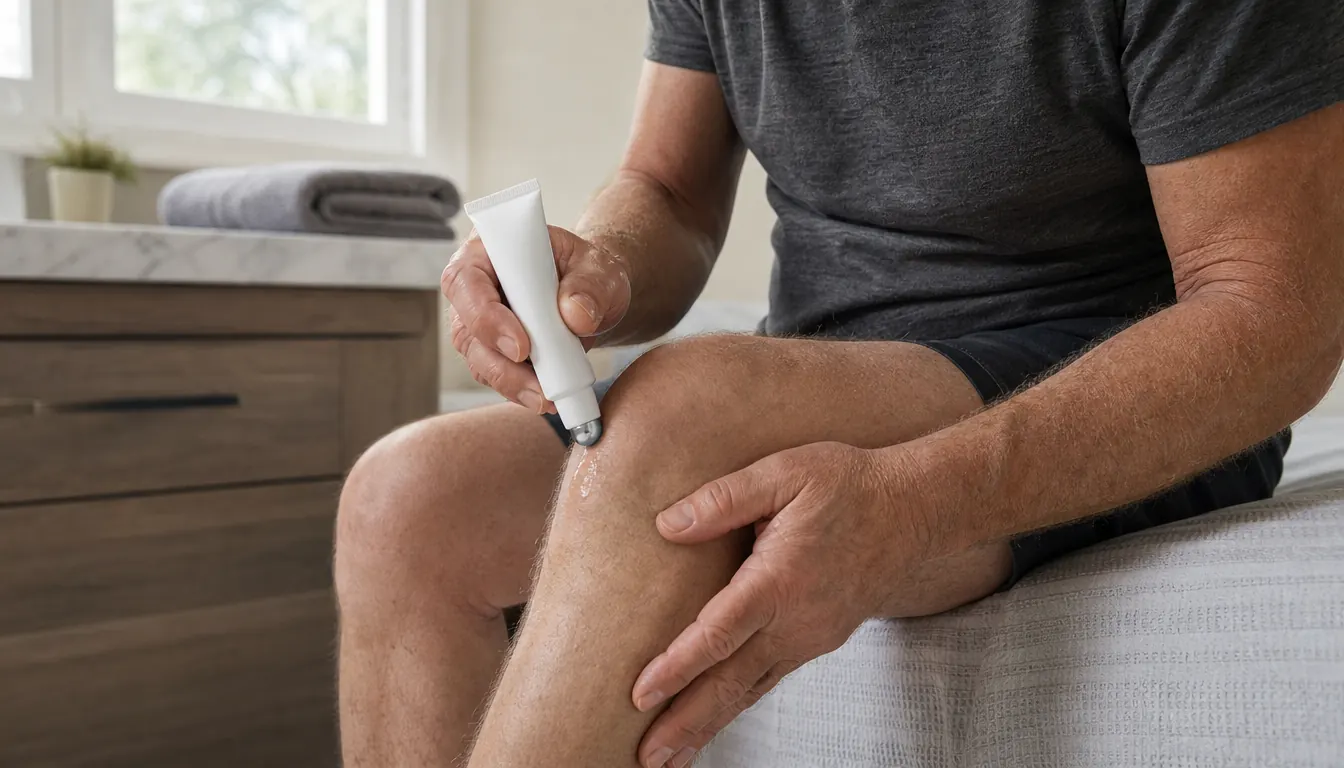
Voltaren Arthritis Pain Gel is a nonsteroidal anti-inflammatory gel that combines the benefits of an arthritis cream and a gel, according to the listing. The active ingredient is diclofenac sodium 1%, equivalent to 0.93% diclofenac. It comes in a 150 g tube with a flip cap. The package calls it the number one doctor recommended topical pain relief brand and says it is clinically proven to relieve arthritis pain, improve mobility and reduce stiffness. I am quoting the label there, not my own medical opinion.
The appeal for me was the word topical. I already take enough things by mouth. A gel that goes on the joint that hurts, rather than through my whole body, was worth asking about. It is not a replacement for the pills my doctor prescribes, and it is not a reason to stop anything else. It is an alternative to pills for some people, which is exactly why the doctor question matters.
The tube is a tube. There is no pump, no dial, no battery, no app. That sounds like a small thing until you have owned a gadget that needed charging before it could help you. I open the cap, squeeze a line onto my finger, rub it in, close the cap, and wash my hands. That is the entire interaction.
I did not expect it to work the first week, and it did not. The listing says clinically proven, which is a phrase from the package, not a promise to me specifically. What I noticed over the first month was not a dramatic drop in pain but a shorter recovery after a walk. I would come home, put my feet up, and the knee would settle in twenty minutes instead of an hour. That is the kind of change you only notice in hindsight.
What Nine Months of Mornings Looked Like
The first month was not a light switch. I noticed that the steady ache on the outside of my right knee was quieter on the days I used it, but I also noticed that some days were simply better than others for reasons that had nothing to do with the gel. Weather, sleep, how long I had sat at the computer, whether I had done my exercises. By the second month I had stopped keeping a formal note and started noticing the pattern instead: the gel helped most on the days after I had done too much.
Winter was the real test. The lake trail iced over and I moved to the mall, which is flat and boring and exactly what a cranky knee wants. I walked two miles, sometimes three, and used the gel before I left on stiff mornings. The cold does something to my knees that I cannot explain, and the gel did not make winter disappear. It made the first ten minutes of the mall loop less like walking on someone else's legs.
By spring I was back on the trail, still at two to three miles. I want to be clear about that. The gel did not give me my four miles back. What it gave me was a way to keep the two and a half I have without feeling like I had borrowed against tomorrow. The last quarter mile is still the last quarter mile. It is just less of a negotiation.
One morning in January I walked the mall loop twice, which is four miles of shiny floor and cinnamon rolls, and I used the gel before and after. The next day my knee was tired but not angry. That is the distinction I care about now. Tired is normal. Angry is what kept me on the couch for a day. The gel did not make me twenty-five again, but it helped me tell the difference.
Where It Helped and Where It Didn't
It helped most with the dull, hot ache that settles in after a day of errands, the kind that shows up when I finally sit down and then stand up again. It helped on the morning after I had spent an hour on my feet in the kitchen. It helped enough that I stopped rationing the tube like it was the last one on earth. I use it when I need it, not on a schedule I invented.
It did not help with the sharp pinch I get on downhill stretches, the one that makes me take the slope sideways like a crab. It did not make the left knee feel any different, because I do not use it there. It did not replace the ice wrap after a long walk. And it did not make me brave enough to skip my exercises. If you want a product that fixes the joint, this is not that, and I do not think any tube on a shelf is.
The honest summary is that the gel lowers the volume. It does not change the station. On a bad day, my knee is still a bad knee. On a good day, I can walk the loop and then go up the stairs to the bedroom without planning each step like a chess move. Nine months in, that is worth something to me. It is not worth everything, and I would not tell you it will be worth everything to you.
I still wear the compression sleeve on the right knee for every morning walk, and I still use the ice wrap after the longer ones. The gel sits between those two tools in my routine. The sleeve gives me warmth and a reminder to pick my foot up. The ice brings the swelling down. The gel takes the edge off the ache that lives in the joint itself. If I had to give one up, it would not be the sleeve.

The Tube, the Cap, and the Small Annoyances
The flip cap is the best part of the packaging. I have arthritis in my hands too, mild, and a screw cap on a small tube is the kind of thing that makes me swear in the bathroom. This one flips up with a thumb. The tube itself is 5.3 ounces and 1.9 by 8.3 by 2.2 inches, so it stands upright in the cabinet and does not get lost behind the cough drops. It is not travel sized, but it is not a gallon jug either.
The gel takes a minute to dry. I put it on and then brush my teeth, which gives it time to sink in before I pull on my walking pants. I do not put lotion on top of it. I wash my hands after every application, because I do not want the stuff anywhere near my eyes, and because I handle food and I do not want to think about it. These are not complaints. They are the cost of using a topical instead of a pill.
One tube lasts me a good while because I use it on one knee and I do not slather it on like sunscreen. I have not run out mid-month yet. When I do, I will buy another one, which is probably the most honest review I can give a product. The bathroom cabinet is where it lives, next to the floss, and that is where it will stay.
The cap does get a little gel on it by the end of the week, and I wipe it with a tissue. The tube stands on the shelf cap down, which keeps the gel near the opening. These are the kind of details I wish more reviews included, because the big claims are on the box and the small annoyances are what you live with.
What I Liked
- Took the edge off the steady ache in my right knee on the days I overdid it
- Topical diclofenac 1% let me ask my doctor about a non-pill option
- Flip cap opens with one hand and the 150 g tube stands up in the cabinet
- Easy to fit into a routine I already had: gel, brush teeth, walk
Where It Falls Short
- Not a cure, and not close to one on stairs or downhill stretches
- Takes a minute to dry and needs hand washing every time
- The label lists hands and feet; my knee was a conversation with my doctor, not a DIY decision
- No effect on the left knee because I do not apply it there
The gel lowered the volume. It did not change the station. I still have the knees I have, but I can walk the loop without planning every step.
Who This Is For
This is for the walker in their fifties, sixties, or seventies whose knees have started to shorten the routine. You have been told to rest, you have rested, and you are looking for something you can use while you keep moving. You have mild to moderate osteoarthritis, you have a doctor who knows your medications, and you want a topical option to discuss. You are willing to use it as the label directs and to keep doing the exercises. Voltaren is the one I asked about, and it is the one I still use.
Who Should Skip It
Skip it if you have not asked your doctor, full stop. A topical NSAID is still an NSAID, and the label has warnings for people with stomach problems, kidney problems, heart problems, bleeding problems, and for people who are pregnant or nursing. Skip it if you are looking for a cure, or if your pain is sharp, new, or accompanied by swelling you cannot explain. Skip it if you want a product that works without any other effort. And skip it if you are not willing to wash your hands, because that is not optional. Ask your doctor or physical therapist before you start, and ask your pharmacist if you are unsure about interactions.
If your knees are shortening the loop, start with the doctor question
I asked my doctor about Voltaren Arthritis Pain Gel before I used it, and I would tell you to do the same. Then, if it is okay for you, the tube is in my medicine cabinet for a reason. It is one small thing that helped me keep walking.
Amazon Check today's price on Amazon →