
The first twenty steps of a morning walk tell you what kind of day it is going to be. Mine used to say: slow down. The right knee would ache before I reached the end of the driveway, and I would spend the next two miles negotiating with it, shortening my stride, telling myself I would turn around at the next bench. I have mild to moderate osteoarthritis in both knees, the right worse than the left. I am not interested in being told to rest it. Walking is the thing I do, and I wanted something I could put on and then forget about.
What I settled on is the Modvel compression knee brace, the two-pack. I have worn one on the right knee on every morning walk for about fourteen months now. The second sleeve is the spare, in the wash or in my bag. It is a pull-on compression sleeve with no straps to fiddle with, made from a nylon and latex blend, and it took me a few tries to work out how to wear it so it actually helped. That is what this is about: the five steps I follow now, in order, learned the slow way.
Fourteen months in, this is still the one I reach for
A pull-on compression sleeve, two in the pack, one on the knee and one in the wash. Snug, warm, and nothing to adjust once you are out the door.
Amazon Check Today's Price on Amazon →The Five Steps I Actually Follow
Before the steps, one plain statement so nobody expects more than they should. A compression sleeve is not a brace and it is not a treatment. It gives warmth and a supported feeling, and for me it makes the first mile of a walk feel like the second mile used to. That is a small thing that turns out to matter a great deal when the alternative is turning around.
Step 1: Get the Fit Right Before Anything Else
Sizing is the whole ballgame with a pull-on sleeve. There are no straps to tighten, so if the size is wrong, nothing you do at the trailhead will fix it. Modvel makes six sizes, and I wear a Large. Before you order, sit down and measure the circumference of your leg at the middle of the kneecap, then again about four inches above it, and take both numbers to the Modvel size chart rather than guessing from your pants size. If you land between two sizes, order to the larger of the two. My first attempt was one size down, on the theory that tighter had to be better. I got about four blocks before the top band had rolled into a hard ridge and the back of my knee was pink and irritated. I finished that walk with the sleeve in my jacket pocket and ordered the right size that afternoon.
What correct feels like: snug all the way around, even pressure, no single spot digging in. You should be able to slide two fingers under the top band. Nothing should pinch behind the knee when you bend it, and the top edge should not roll down as you walk. If it leaves a deep groove in your skin after twenty minutes, it is too small. If it has slid down your calf by the end of the block, it is too big.
One more detail, and it is not optional. The listing says the material is a nylon and latex blend. If you have a latex allergy, read the label and check with the manufacturer before you put it on. I do not have one, so it was not a factor for me, but it is the kind of thing that is easy to miss when you are buying quickly.
Step 2: Put It On Before You Leave the House
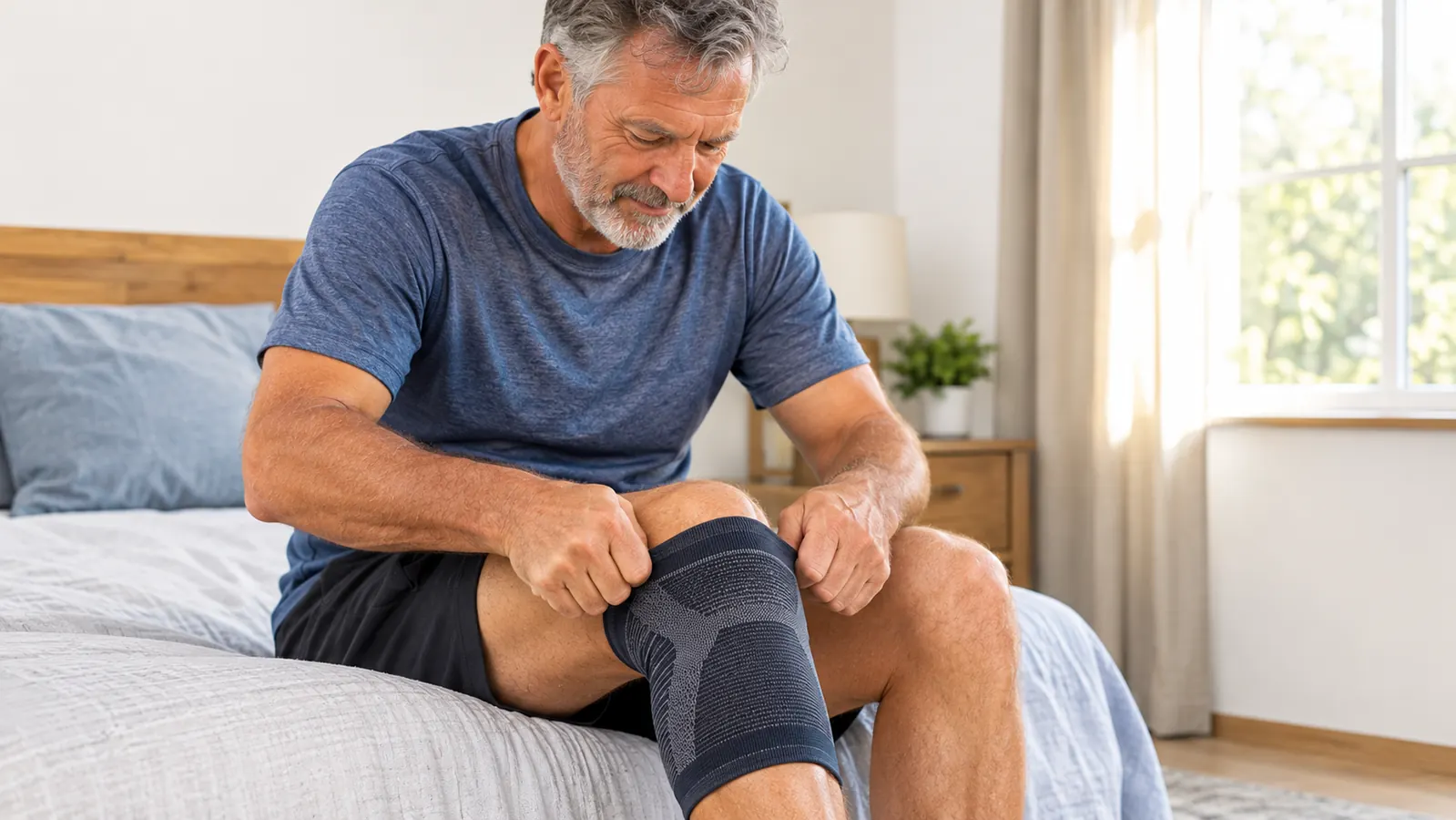
Put the sleeve on at home, sitting on the edge of the bed, before your shoes go on. Not standing in the driveway, not at the trailhead with one hand on the car roof. Standing makes it harder to bring the sleeve up over the calf evenly, and doing it in a hurry is how you end up with a wrinkle behind the knee that you feel for the next two miles.
The method I use: sit down, roll the sleeve up from the bottom the way you would roll a sock, slide your foot through, and work it up your calf in stages. Bring the front over the kneecap first, then the back. Stand up, bend the knee twice, and smooth out any folds, especially in the crease behind the knee. It should sit centered on the kneecap, not pulled up above it and not bunched below it.
This takes about thirty seconds once you have done it a few times. The first week it took me closer to two minutes and I got it crooked twice. Do it before your shoes, every time. Bending down to tie a lace with a fresh sleeve on is fine. Standing on one leg to haul the sleeve up is not. The one morning I skipped this and did it in the car at the lake, I spent the whole walk aware of a fold behind my knee and stopped twice to pull it straight. There is no good place to fix a sleeve once you are moving, and no bench comfortable enough to make it worth trying.
Step 3: Wear It for the Walk, Then Take It Off
I wear the sleeve for the walk and it comes off when I get home. My morning loop is two to three miles on the paved trail around the lake near my house, which is forty minutes to an hour depending on how many neighbors stop to talk. That is the window. It is not something I put on at seven in the morning and wear until dinner.
Compression that stays on for hours does not do more good, and it does start to irritate skin. When I get back, the sleeve comes off before my shower, I look at the skin behind the knee and under the top band, and I let the knee breathe. My rule after a walk is simple: if the skin under the top band is still red five minutes after the sleeve comes off, it was too tight that day and I check the fit before the next one. If it is faint and gone in a minute, that is normal for me. If I am going out again later and I know I will be on my feet a while, I put it back on for that. Two sessions in a day is fine. All day is not something I would do.
There is a real limit to what a sleeve does, and I would rather say it plainly. On a bad morning it takes the edge off the first mile. On a good morning I forget I have it on, which is the point. It does not brace the joint rigidly and it does not fix anything, and if you expect those two things you will be disappointed by every sleeve you buy.
It did not give me a new knee. It gave me back the first mile, and the first mile was the one I kept losing.
Step 4: Use the First Five Minutes to Warm Up
The sleeve is one part of the morning. The other part is the first five minutes. I start slower than I want to, on the flat stretch, and I do not chase my old pace. Whatever is stiff gets five minutes of easy walking to loosen up. If the knee is still angry after that, I turn around. That rule has saved more walks for me than any piece of equipment I have bought.
The hard parts of my route are specific. There is a long downhill stretch on the back side of the lake, and downhill is worse for me than uphill. I set my trekking poles a little shorter for that section and use both of them, which takes load off the knee. In January, when the trail is icy, I do not walk it at all. I go to the mall or use the treadmill in the basement, sleeve on, same five-minute warm-up.
The other change that helped was under my feet. I noticed my knees felt better on the dirt shoulder of the trail than on the concrete path, which told me the surface mattered more than I had given it credit for. I put a pair of plush foam insoles in my walking shoes, trimmed them to fit with scissors along the guide line, and replaced them after about six months when they had flattened out. The difference is not dramatic. It is the difference between finishing the concrete stretch comfortably and finishing it because you decided to. Small thing. It made the concrete less punishing.
Step 5: Wash It by Hand So It Keeps Its Grip
A compression sleeve only works while it still compresses. Mine gets washed by hand in cool water with a little mild soap, rinsed until the water runs clear, rolled in a towel to press the water out, and laid flat to dry. It never goes in the dryer. Heat is what kills elasticity, and a sleeve that has been through the dryer is a sleeve that slides down your calf. I do it in the laundry room sink, and I squeeze the soapy water through the fabric rather than wringing it. Wringing is how you stretch the band out months early.
This is where the two-pack earns its place. One sleeve is on my knee, one is clean and dry in the top drawer of my dresser, and they trade off. I am never waiting on laundry to take a walk, and each sleeve gets days off to recover. Mine gets washed roughly once a week, more often in summer.
Eventually the top band stops holding and the sleeve starts to feel loose rather than snug. My first Modvel sleeve went about eight months of near-daily wear before I noticed the difference. When that happens, replace it. A stretched-out sleeve is the same as wearing nothing, except you keep expecting it to help, which is worse than knowing.
What Else Helps
The sleeve is the thing I wear, not the whole routine. After a longer walk or a day of stairs, I use a gel ice wrap for fifteen to twenty minutes with a thin cloth between the pack and my skin. The wrap hangs on a hook in the laundry room and the gel packs live in the kitchen freezer, so it takes about a minute to set up, which is the only reason I actually do it. On stiff mornings I warm the gel pack first and use it before I head out, which makes the first block easier. I also use an over-the-counter diclofenac gel on the right knee, as the label directs, and only after asking my doctor whether it was fine with my other medications. It takes the edge off achy days. It is not a cure and I do not treat it like one.
None of this replaces the two people who actually know what they are talking about. My doctor diagnosed the arthritis, and my physical therapist gave me the strength work I still do twice a week, which has done more for my knees than anything I have bought. Ask yours before you add compression, ice, or a topical gel to your routine, particularly if you have circulation problems, diabetes, or a latex allergy. A sleeve is a small tool. Use it like one and it earns its place in the drawer.
Start with the size chart, then take the first mile slow
Two sleeves, one on the knee and one drying in the drawer. Pull-on, snug, nothing to adjust once you are out the door. It is the thing I have worn every morning for fourteen months.
Amazon Check Today's Price on Amazon →