Forty yards. That is the length of the downhill stretch on the lake trail near my house, and for most of a year it was the part of my morning walk I thought about before I thought about anything else.
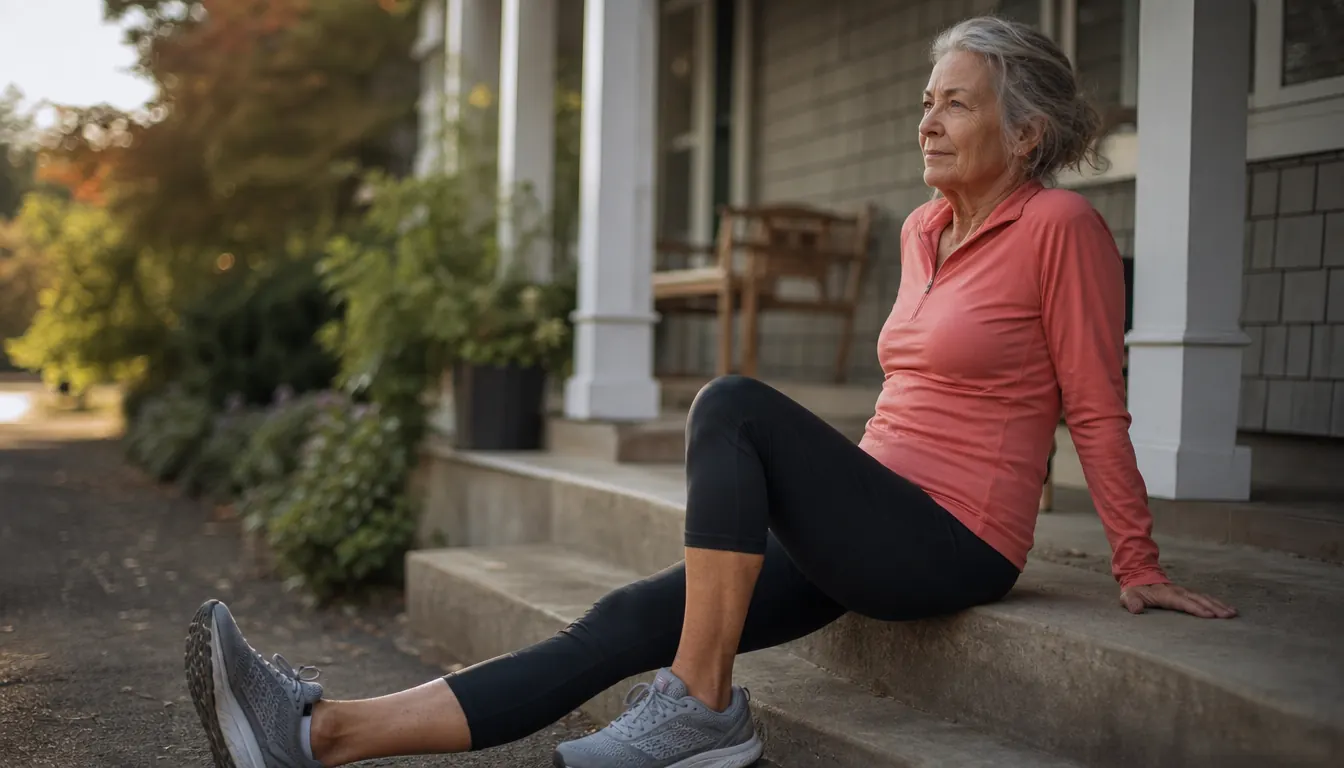
I am 61, I live in Bloomington, Minnesota, and I have mild to moderate osteoarthritis in both knees, my right worse than my left. My doctor told me that about three years ago. Before my knees started complaining, I walked four miles most mornings, usually the paved loop around the lake. Now I walk two or three miles on a good day, and I have spent a fair amount of money and one whole shelf in the laundry room trying to hold onto even that. The Vive Knee Ice Pack Wrap is the one that stayed. I have had it about eleven months, long enough that the novelty is gone and the gel packs have been refrozen more times than I could count. What follows is what I actually noticed, using it after daily walks through a Minnesota spring, summer, fall, and one long winter I mostly spent on the treadmill in the basement.
The Quick Verdict
The wrap I reach for four or five times a week, eleven months in. Cold after a walk, warm before one, and the closure has never once let go on its own. It does not steady the knee, and it is bulky under fitted pants.
Amazon Check Today's Price →The one thing on my laundry room hook that never got retired
Eleven months, three gel packs rotating through the kitchen freezer, and the closure still grips the way it did in week one. If your knee is the reason your walk got shorter, this is the first thing I would buy.
Amazon Check Today's Price on Amazon →How I've Used It
Cold, mostly, and after the walk rather than before it. On a normal morning I come in, put my shoes by the back door, take a gel pack out of the kitchen freezer, lay a thin dish towel over my right knee, and put the wrap on for fifteen to twenty minutes while I sit with a book and a glass of water. The towel is not optional. The packs come out cold enough that bare skin is genuinely unpleasant, and the wrap holds them snug against the joint whether I sit still or keep shifting around.
Warm on the stiff mornings, maybe twice a week and more often in winter. Some days my right knee is cranky before I have done anything to earn it. On those mornings I warm a pack, wear the wrap for a few minutes while I drink my coffee, and by the time I am lacing my shoes the joint has loosened enough to walk on. I want to be plain that this is comfort, not treatment. My doctor has been clear with me that nothing I strap to the outside of my knee is changing the arthritis inside it, and I am not claiming otherwise.
The first two weeks were mostly me figuring out how tight to pull the closure. Too loose and the pack slides down the leg. Too tight and I can feel my pulse in my shin. What works for me is snug enough that the wrap does not shift when I stand up, and no tighter. If you are unsure, start looser. You can always press the closure down again a few minutes in.
There was a Saturday in October that made the case for me better than any description could. I did the grocery run, the pharmacy, and the hardware store on foot because the parking is easier that way, and by the time I got home and up the stairs my right knee was full and hot to the touch. I put the wrap on with a cold pack, sat for twenty minutes, and stood up without the usual pause. Nothing dramatic happened. That is the entire review, repeated four or five times a week for most of a year.
What turned this from a phase into a habit was where I put it. The wrap hangs on a hook in the laundry room, which I walk past eight times a day. The gel packs live in the kitchen freezer, in the door, where I see them every time I get ice. When the wrap lived folded in a drawer I forgot it existed. Hanging where I can see it, I use it four or five times a week without thinking about it.
What It Is and How It Goes On
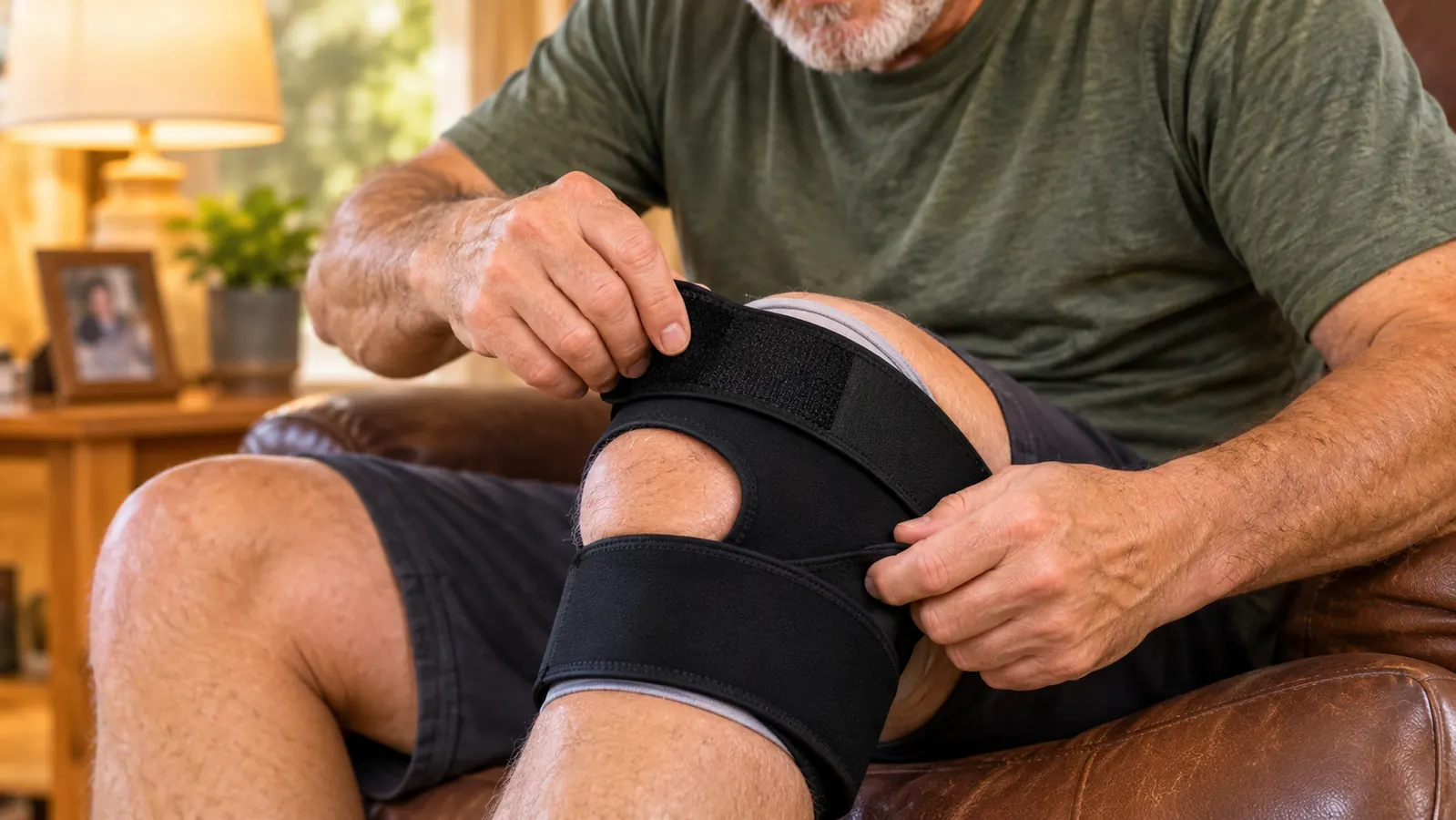
The Vive wrap is a neoprene sleeve that opens flat, wraps around the knee, and closes with hook and loop. You are not pulling it up over your foot the way you would with a closed sleeve. You lay it around the knee and press the closure down. On the days when bending far enough to reach your own foot is part of the problem, that difference is the whole reason the thing gets used.
It ships with three removable Arctic Flex gel packs, and the wrap is cut so packs sit against both the front and the back of the knee. That front and back coverage is the part I did not expect to care about and now do. After a walk, most of what I feel is at the front of the knee. After a day of errands and stairs, the stiff, full feeling is behind the joint. One wrap covers both without me rearranging anything halfway through.
Getting the packs in place takes a few seconds. Each one presses against the inside of the neoprene, and you can feel through the wrap roughly where it has landed without taking the thing off again. I put the front pack a little below the kneecap, where the ache usually starts, and the back pack centered behind the joint. In eleven months I have not had one work its way loose mid-session, which genuinely surprised me through the first month of use.
The product listing gives a fit of up to twenty-one inches of knee circumference. My knee is well under that, and there is still a good overlap where the closure meets, which is why it stays put through a whole chapter of a book. If your legs are on the larger side, measure before you order instead of guessing, because the fit is what turns a gel pack into compression.
It is machine washable, which matters more than it sounds. A wrap you wear against your skin four or five times a week gets to smelling like a gym bag otherwise. I wash mine every couple of weeks on a gentle cycle and let it air dry, and after eleven months the closure has not curled, frayed, or stopped gripping. The 60 day guarantee is the other thing worth knowing about. I did not need it, but I like that it is there.
Eleven Months of Freezing, Refreezing, and One Honest Complaint
Gel packs are usually the part of any ice wrap that quietly dies. I have had cold packs split at a seam and leak into a freezer drawer. Eleven months in, all three of these are intact, and the plastic has not gone stiff the way some do after a few dozen trips through a freezer. I have not been gentle with them either. They get tossed in the door shelf next to the frozen peas.
The complaint is time. A frozen pack stays properly cold for roughly fifteen to twenty minutes in my experience, and then it is finished. If I want longer, I am swapping a pack mid-session. That is not really a flaw, since nobody needs an hour of cold on a knee, but it does mean the other two packs have to be frozen and ready or the whole thing becomes a fifteen-minute event followed by nothing at all.
Winter changed my routine more than it changed the wrap. From December into March I walked on the treadmill in the basement, which is flatter and more forgiving than the trail, and my knee complained less after those sessions than after a real walk outdoors. I still used the wrap, mostly because the stairs in a two-story house do not care what season it is. The packs came out of the kitchen freezer just as often in January as they did in July.
The second note is bulk. Under loose jeans or sweatpants it is unnoticeable. Under anything fitted it looks exactly like what it is, a knee with a cold pack strapped to it. In summer I wear shorts, use the towel, and answer the door in it, which tells you something about how much I care by August.
The third note is warmth, in the wrong season. Neoprene does not breathe the way a cloth wrap does. On a humid July evening, twenty minutes in this is twenty minutes with a warm band around your leg, cold pack or no cold pack. It has never stopped me from using it. It is the reason I reach for it somewhat less in July than in January.

What I Tried Before This, and Where the Wrap Fits
This was not the first thing I bought. The first was a compression knee sleeve, which I still wear on every single walk. The sleeve is support and warmth during the walk. The Vive wrap is what I use afterward, and on stiff mornings before. They are not competing for the same job and I would not want to give up either one.
Before the wrap, I did what everyone does, which is a bag of frozen vegetables and a dish towel. Peas do not stay where you put them. They warm up fast. They smell like a freezer and then they go back in the freezer, which nobody in my house appreciated. Going from that to a wrap with a closure and a removable pack was the difference between something I did twice and something I do four or five times a week.
The insoles came later, after I noticed that my knees felt better on the softer trail than on the concrete sidewalk by the post office. I trimmed a pair to fit my walking shoes along the guide line and that helped too, in a quieter way. The trekking poles came last, for the downhill stretch and the icy sidewalks. None of those replaced the wrap. Each one took a piece of the problem, and the wrap took the part that happens after you stop moving.
I also asked my physical therapist, back when I was seeing one for about eight weeks, whether I was wasting my time with any of this. Her answer, in substance, was that cold after activity and warmth before it are reasonable things to try, and that the walking itself was the part that mattered most. That is the frame I have kept. The wrap is not the treatment. The wrap is what lets me keep doing the thing that is the treatment.
What I have landed on is a sequence rather than a purchase. Compression sleeve for the walk. Wrap with a cold pack for fifteen to twenty minutes afterward. A warm pack on the stiff mornings. It takes less time than the drive to the trail, and after eleven months it is the only part of my routine I have not quietly abandoned.
What I Liked
- Three gel packs means one is on the knee, one is back in the freezer, and one is waiting
- Covers the front and the back of the knee at the same time without repositioning
- Hook and loop closure stays where you set it, even while you shift around on the couch
- Fits knee circumferences up to 21 inches with room left over at the closure
- Machine washable, and the closure has held up through eleven months of near daily use
- Works cold after a longer walk and warm on the mornings when the knee is stiff before you start
Where It Falls Short
- Cold fades after roughly fifteen to twenty minutes, so a longer session means swapping a pack
- Bulky under fitted pants, obvious under anything slim
- Neoprene holds heat, so it is less pleasant on a humid summer evening
- Gives compression and temperature only, no rigid support for an unsteady knee
- You have to remember to refreeze the packs, and forgetting means no wrap
Eleven months, three gel packs, one hook in the laundry room, and I still reach for it four or five times a week.
Who This Is For
If your knee is the reason your walk got shorter, and the soreness shows up after the walk rather than during it, this is the most useful thing I have bought in three years of buying things for my knees. It suits the person who has been told to ice the joint and has been doing it with a bag of frozen peas and a towel that keeps sliding off.
It also suits anyone who has trouble getting a tight sleeve on and off. Not having to pull anything over your foot is a real advantage on the days when your knee is at its worst and reaching your own ankle is a project. If you have stairs in your house, as I do, the session after a day of errands is where this earns its keep.
Who Should Skip It
If what you want is steadiness on uneven ground, this is not that. The wrap gives compression and temperature. It does not give structure, and it will not stop the knee from feeling unreliable on a downhill stretch. That is a question for a brace, or for your physical therapist, or both. I would not want anyone buying this expecting it to keep them from turning an ankle on a root.
Skip it too if you will not keep the packs frozen. The wrap is only as good as the pack you put in it, and a room-temperature gel pack is a neoprene band with extra steps. And if sitting still for twenty minutes with a cold knee sounds like a waste of an evening, be honest with yourself before you order, because that is the entire product. Check with your doctor about cold and heat either way, particularly if you have circulation problems or changes in sensation in your feet.
Start with the twenty minutes after the walk, not the walk itself
Eleven months in, the Vive wrap is the only piece of my knee routine I have not abandoned. Three gel packs, one hook in the laundry room, and a closure that still holds.
Amazon Check Today's Price on Amazon →