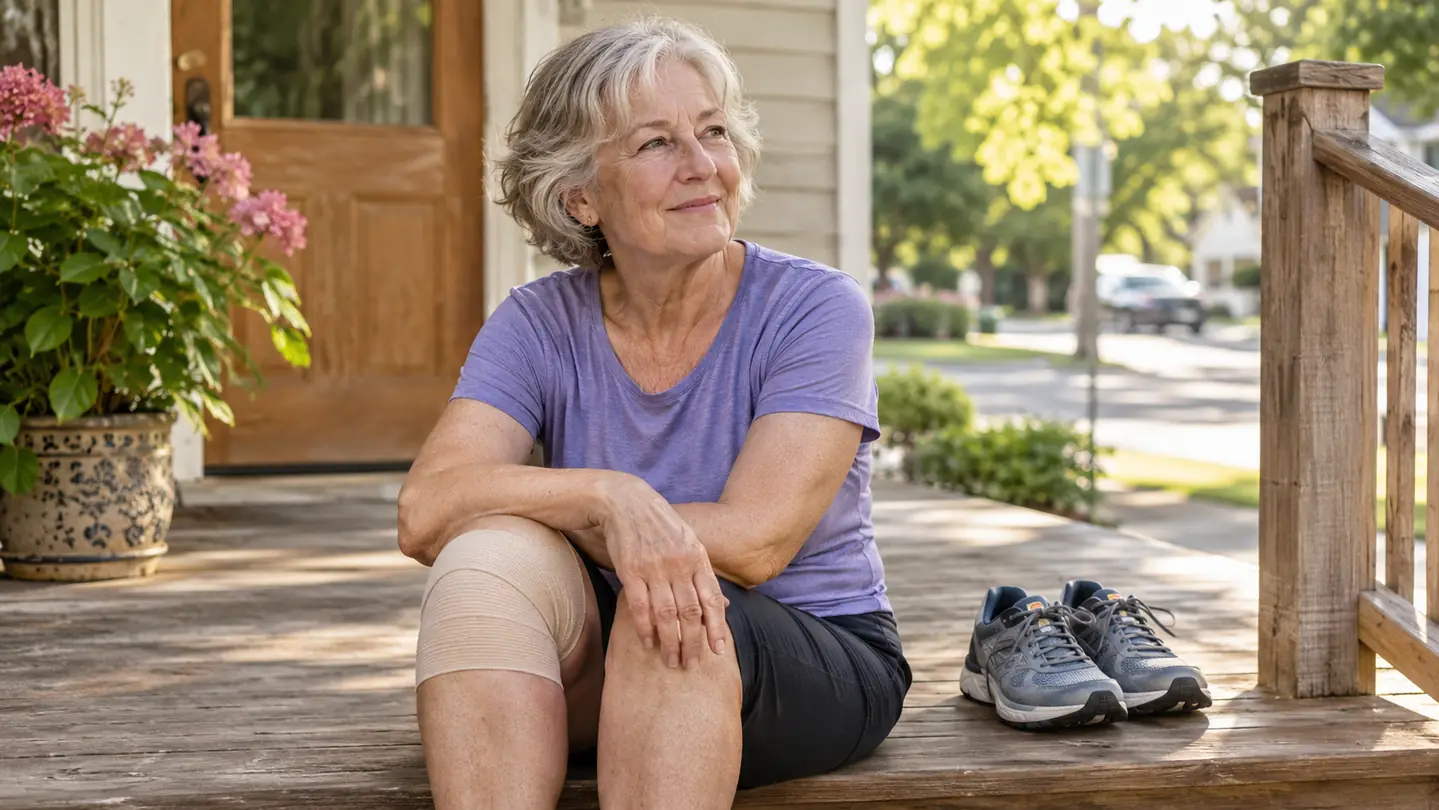
The last half mile of my lake loop used to be the part I looked forward to. Now it is the part I negotiate with. I am 61, I live in Bloomington, Minnesota, and about three years ago my doctor confirmed what I had already suspected: mild to moderate osteoarthritis in both knees, the right one worse than the left. Stairs, long downhill stretches and getting up after sitting are the hard parts. My walks went from about four miles to two or three on a good day. What nobody told me, and what I had to work out on my own front steps, is that the walk itself is not what leaves me stiff. It is the twenty minutes after the walk, when I sit down and do nothing.
That is where the Vive knee ice pack wrap comes in. It is a neoprene wrap with three removable Arctic Flex gel packs, it closes with hook and loop straps, and it fits knees up to 21 inches around. I have used mine for about eleven months and have replaced nothing on it in that time. It hangs on a hook in the laundry room and the gel packs live in the kitchen freezer. This is not quite a review. It is the routine I built around it, step by step, because the wrap on its own did very little for me until I stopped using it wrong.
The Twenty Minutes After the Walk Are the Ones That Count
The wrap goes on while my knees are still warm from walking, not an hour later when they have gone stiff and cranky. That one change in timing did more for my afternoons than anything else on this page. Check the current price and the sizing on Amazon before you order.
Amazon Check Today's Price on Amazon →Step 1: Time It to the Walk, Not to the Clock
My physical therapist, who I saw for about eight weeks, was the one who pointed out that I was doing this at the wrong time of day. Before that I had been using a bag of frozen peas wrapped in a pillowcase, which is what my mother would have done, and it slid off my knee every time I shifted on the couch. I used to walk, shower, eat lunch, run errands, and then put the wrap on at four in the afternoon, by which point my knees had already gone stiff and cranky. I was chasing the ache instead of heading it off.
Now the Vive wrap goes on within twenty or thirty minutes of my walking through the back door. Shoes off, wrap on, sit down with a book. My knees are still warm from the trail, and fifteen minutes of cold at that point does more for me than thirty minutes does at four o'clock. That is my experience, not a rule from a textbook. Ask your own doctor or physical therapist what timing they want for you.
It matters most on the days that are hardest on knees. For me that is the downhill stretch on the north side of the lake, where the pavement tilts and I feel every step in the right knee, and any day I take the stairs at home more than usual. We have a two-story house, so stairs are not optional in my life. On those days I do not skip the wrap because I am tired. I put it on first and then I am lazy. The order matters more than the effort.
Step 2: Put a Thin Cloth Between the Pack and Your Skin
The first month I used this thing I did it wrong. I pulled a gel pack straight out of the kitchen freezer and strapped it against bare skin, and after about eight minutes it stopped feeling like relief and started feeling like a burn. Neoprene holds the cold in. The gel pack comes out of the freezer stiff as a board, and I sat there telling myself it was working because it hurt. That is not a system. That is just being stubborn in a chair.
Now I keep a thin cotton dish towel folded into a strip, and that goes between the gel pack and my knee. One layer is enough for me. Two if the pack came out of the coldest corner of the freezer, which in mine is the back left shelf, right above the ice cube tray. The wrap still feels properly cold through the cloth, just not biting, and I can leave it on for the full time without watching the clock like a hawk.
This is the step people skip when they are in a hurry, and it is the step that decides whether the whole thing is pleasant or miserable. If your skin looks pink and angry when the wrap comes off, the cloth was too thin or you left it on too long. Mine looked like that exactly once, on a Saturday morning in March when I was rushing to get to the grocery store before the snow started, and I have used the towel ever since. The towel lives folded on the shelf beside the wrap now, so there is no excuse.
My measurement is simple. Before the wrap I go down the stairs one step at a time, both feet on every tread. Twenty minutes after, I go down like a normal person.
Step 3: Wrap It Snug, Not Tight
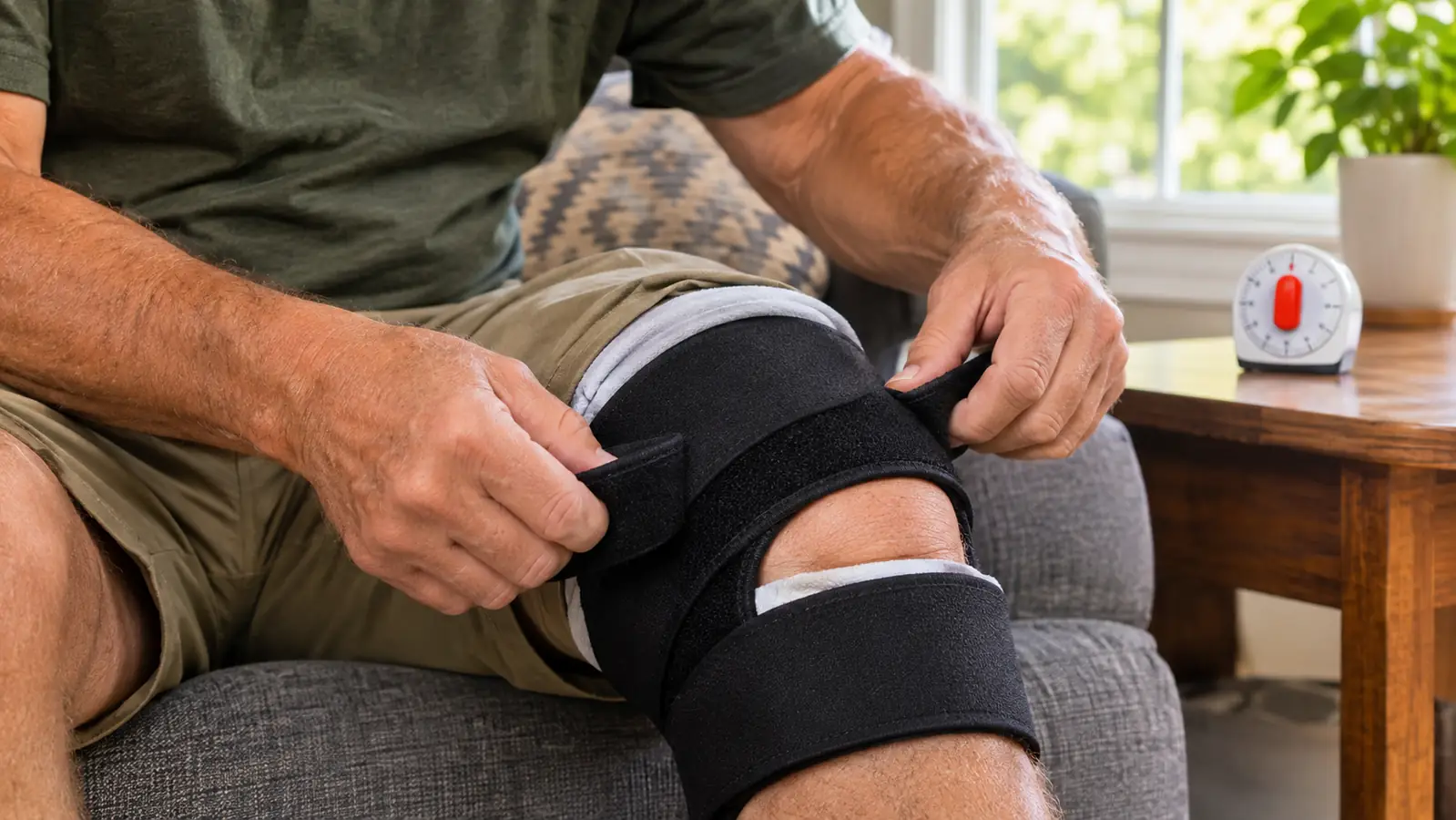
The Vive wrap has hook and loop straps and fits knees up to 21 inches around, which leaves plenty of room to overtighten. I did that for a week. My calf went numb by the end of a walk and my foot felt cold in a way that had nothing to do with the weather. Numbness is not the point. The point is gentle compression that holds the packs where they belong, and the wrap does that on its own if you let it.
What works for me is snug enough that the wrap does not shift when I stand up, and loose enough that I can slide two fingers under the edge. The straps let me set the top and the bottom separately, which matters because my right knee is noticeably bigger than my left when it is annoyed. One strap tight, one strap easy, and the wrap stays put for the full twenty minutes without me hiking it back up every four minutes.
The wrap covers the front and the back of the knee, so I put one gel pack over the front and one behind it. The third pack stays in the freezer as the next one in rotation. If you only use one pack, put it where your knee actually complains, not where you think it should. Those were two different spots for me, and it took me a month to notice. The ache I feel at the top of the stairs is not in the same place as the ache I feel after the trail, and I had been icing the wrong one.
Step 4: Fifteen to Twenty Minutes, Then Stop
Twenty minutes is my number. Not because twenty is magic, but because at twenty-five I get restless and start shifting, and at thirty my knee feels wooden for an hour afterward. Cold for too long is a real thing. I learned it the way I learn most things, by overdoing it first. My first attempt at being efficient was leaving the wrap on through an entire episode of a show, which ran about forty-five minutes, and my knee ached in a different, deeper way for the rest of that evening. Not the sharp ache I was trying to fix. A dull one I had caused myself.
I use a kitchen timer now, which sounds fussy until you have zoned out with a book and looked up to find the wrap has been on for fifty minutes. Fifteen is my minimum on a short walk day. Twenty on a long walk day, or a day of errands on my feet, or a morning when the stairs at home have already made their opinion known. My rule is simple: the harder the day, the closer to twenty, and never past it.
When the timer goes, the wrap comes off and I stand up and walk around the kitchen. If the knee feels better, good. If it does not feel better after a few honest tries on different days, that is a conversation for my doctor, not a reason to leave the wrap on longer. Longer is not stronger here. It is just colder. I also do not sleep in it. I tried that once, thinking I would wake up improved, and woke at two in the morning with a cold, damp knee and a strap twisted around my calf.
Step 5: Freeze It Flat and Put It Back Where You Will Find It
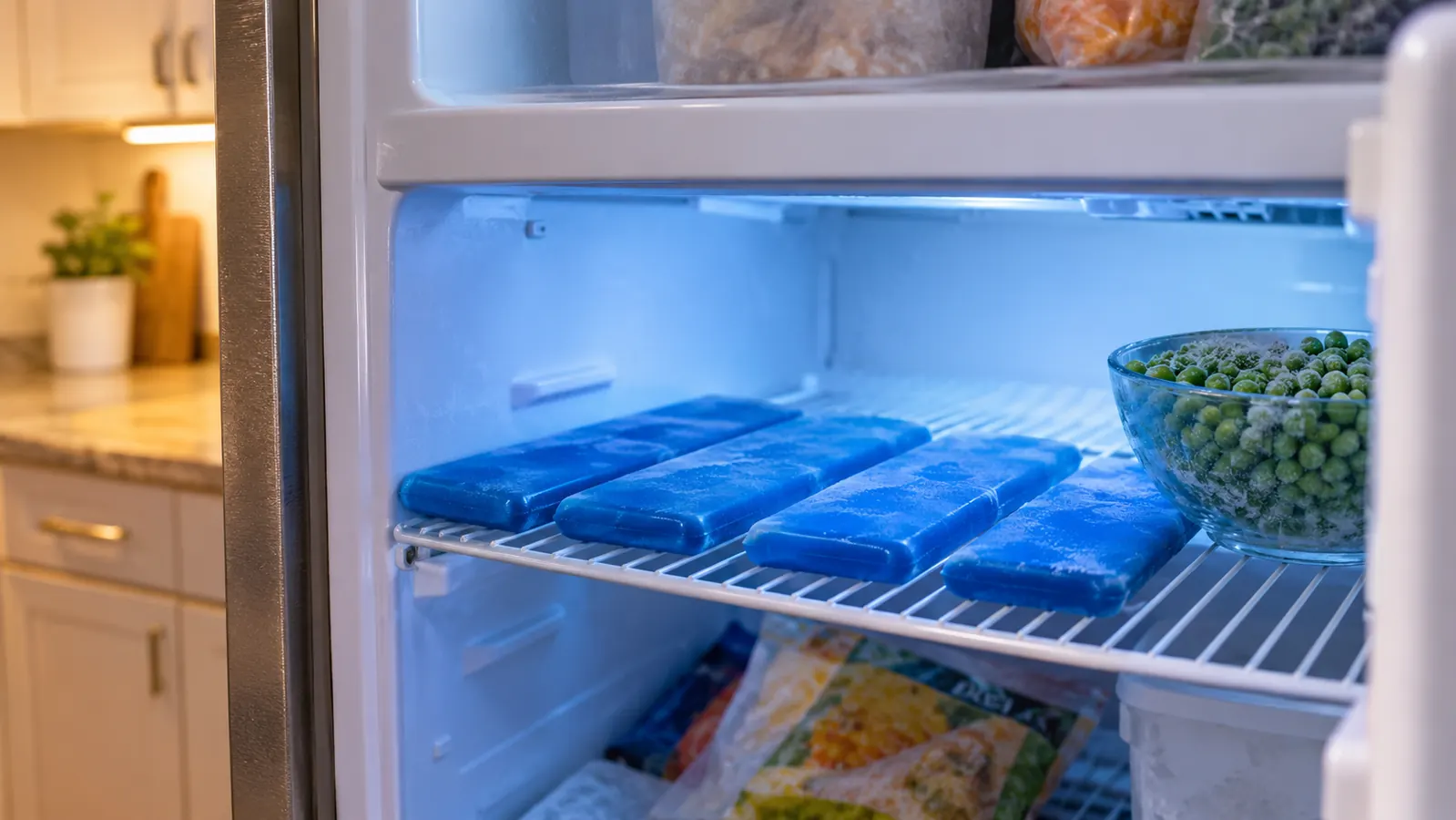
Three gel packs is the right number, and it only works if they are actually frozen when you need them. Mine lie flat on a wire shelf in the kitchen freezer, not stacked in a pile, because a flat pack wraps around a knee and a lumpy one does not. Flat also freezes faster, which matters at seven in the morning on a January day when I want the warm version before I walk and the cold version waiting for me when I get back.
The wrap itself hangs on a hook in the laundry room. That is the whole storage system, and it exists because I once left the wrap in a heap on the couch for three days and then could not find it on a morning when I wanted the warm version before walking. Not a crisis. Just annoying, and completely avoidable. Now the towel, the wrap and the timer all live within arm's reach of each other, and the routine takes about ninety seconds to set up.
The wrap is machine washable, which I do about once a month, and I air dry it rather than putting it in the dryer. The gel packs go back in the freezer the moment I take them off, before I sit down, because the version of me that sits down first does not get up again for an hour. Vive builds in a 60 day guarantee on the wrap. I have never needed it, but I like knowing it is there.
What Else Helps
The wrap is one piece of a routine, not the whole routine. The other pieces matter, and I would be lying if I said the wrap did everything on its own. It does not. What it does is make the rest of the day possible, and that is a smaller claim than it sounds, because a knee that stiffens up after every walk slowly talks you out of walking at all.
A compression knee sleeve on the walk itself. I wear one on my right knee every morning, snug and warm, not rigid, and it makes the walk feel less like work. My physical therapist suggested light support when I first started back after my knees flared, and I never stopped. I hand wash it and let it air dry, and the spare is in the wash more often than not.
Voltaren gel on the achy days, used exactly as the label directs, after I asked my doctor whether it was fine alongside my other medications. Plush insoles in my walking shoes, because I noticed my knees felt better on the soft trail than on concrete and it took me a year to connect those two facts. Trekking poles for the downhill stretch and for icy sidewalks in January, set a little shorter going down. And warm, not cold, on the stiff mornings: a gel pack in warm water before I walk, cold after.
None of that replaces the advice you get from your own doctor or physical therapist. Mine is the only pair of knees I have, and I am not qualified to tell you about yours. What I can tell you is what the twenty minutes after a walk look like at my house, and that the difference between doing this and not doing it is the difference between two miles and half a mile.
Eleven Months In, It Still Hangs on the Hook in My Laundry Room
Three gel packs, one wrap, a thin cloth and a kitchen timer. That is the entire setup, and it is the reason I still get my two miles most mornings. If your knees have started shortening your walks, this is the simplest place I know to start. Check the 21 inch sizing against your own knee before you order.
Amazon Check Today's Price on Amazon →