
For about three years my knees have had a vote in how far I walk. Some mornings I get my two and a half miles around the lake near my house in Bloomington, Minnesota. Other mornings it is a flat no, and I turn around at the first bench. My doctor calls it mild to moderate osteoarthritis in both knees, the right worse than the left, and he says the same thing at every visit. Keep walking, just be smarter about how.
Being smarter, it turns out, has a lot to do with what sits between my foot and the ground. I ignored that for years. I bought walking shoes and never once looked inside them. Then I noticed something hard to argue with. On the soft crushed limestone stretch of the trail my knees behaved. On the concrete sidewalk by the parking lot they did not. Same legs, same distance, same morning. The only variable was the surface, and the only part of the surface I could change was the cushioning inside my shoe. That is how I came to Dr. Scholl's Walk Longer Insoles, which now live in the shoes by my back door. I am not a medical person and none of this is medical advice. I checked with my physical therapist before I changed my footwear.
The one layer you can change before your next walk
Dr. Scholl's Walk Longer Insoles are the plush foam pair I keep in my walking shoes by the back door. They come in women's 6 to 11 and they are listed for walking, hiking and standing, which is exactly the list I needed. Foam, arch support, low arch.
Amazon Check today's price on Amazon →Step 1: Read the ground before you read a single insole review
Before I bought anything I spent a week paying attention to where my knees actually hurt. Not the general ache, the specific moments. Mine were three. The last quarter mile back to the parking lot, which is all concrete. The downhill stretch past the boat launch. And the first ten steps after I stopped to talk to a neighbor. That last one had nothing to do with the ground and everything to do with stiffness after standing, which is a different problem entirely. Knowing which was which saved me from buying the wrong thing.
So do the boring version. Walk your usual loop twice this week and count how many minutes of it are concrete, asphalt, packed gravel or grass. Concrete is the one that sends the shock straight up. If most of your walking is on a sidewalk, or on a mall floor in January, cushioning matters more to you than it does to somebody whose whole loop is crushed limestone. And if your knees only complain on the downhill, the fix might be your pace and your stride rather than anything inside your shoe.
The week I did this, my loop broke down to eleven minutes on concrete sidewalk at the start, twenty-two minutes on packed gravel around the lake, and six minutes on the asphalt path down to the boat launch. Twenty-eight of my thirty-nine minutes were on something hard. That number did more to change my mind than any review I read, and it is the reason I stopped shopping for a general purpose insole and started looking for cushioning built for walking. A soft pad aimed at dress shoes would not have survived my Tuesday.
Step 2: Decide what kind of cushioning your knees are asking for
There are two complaints and they want different things. The first is impact soreness, the kind that builds through a walk and settles down an hour after you stop. That one responds to plushness, to something that absorbs the hit before it travels up. The second is stiffness, the kind you feel in the first few minutes and after sitting. That one responds less to cushioning and more to warmth and movement, which is a conversation to have with your own care team. I had both. The cushioning helped the first one. Nothing I put in a shoe fixed the second.
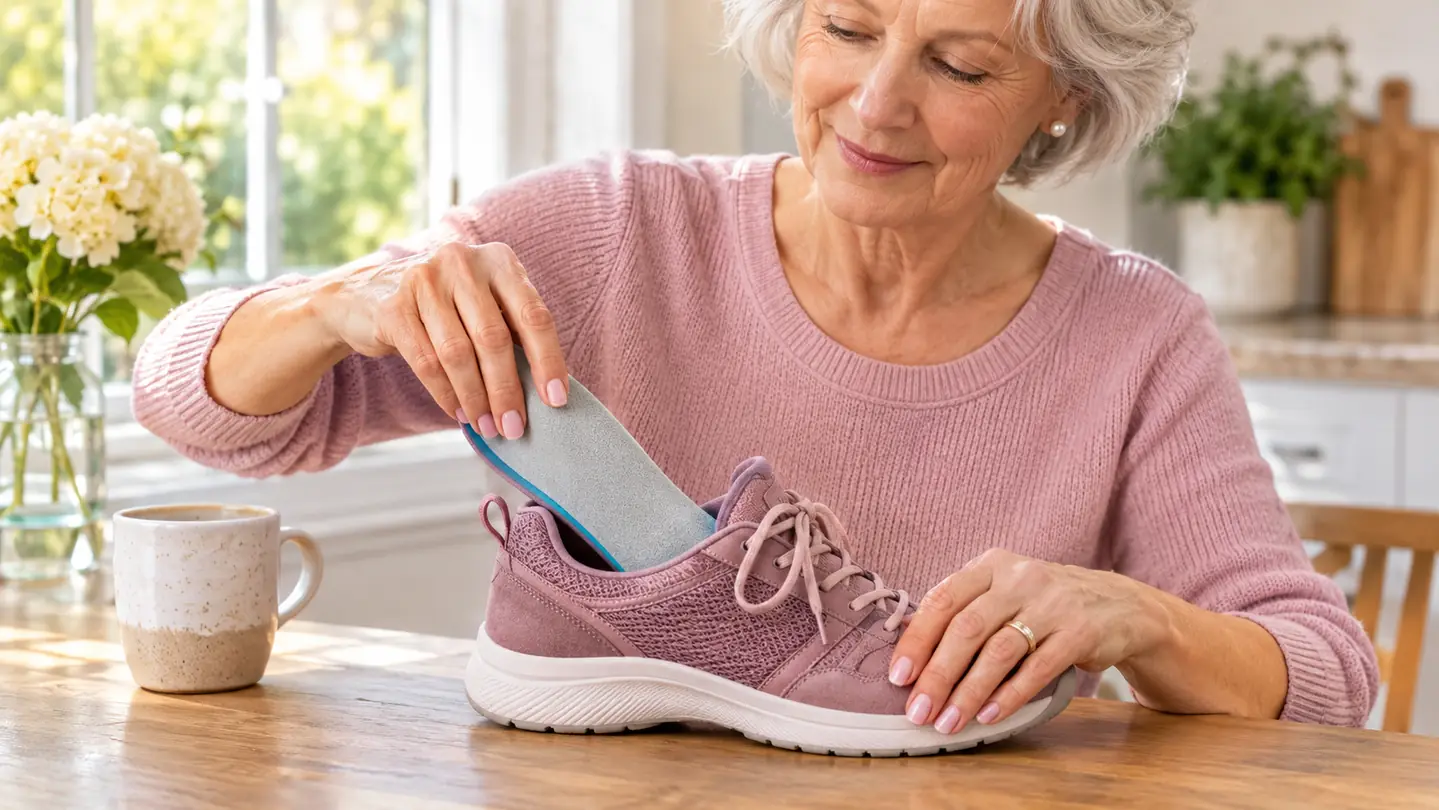
What I wanted was foam with some give to it, not a thin gel pad that feels like nothing after a mile. The Dr. Scholl's Walk Longer Insoles are plush foam, and the plush part is not marketing language. When I press my thumb into one it sinks and comes back. The packaging claims you can walk longer without muscle fatigue, which is a big claim and not one I can verify in my own legs. What I can tell you is that by the third week I was finishing the concrete stretch without the small hitch in my step that I had stopped noticing because it had been there so long.
The heel is where I noticed the difference first, because that is where I land. There is a real gap between an insole that is soft under the ball of the foot and one that has something under the heel to take the drop. On the concrete stretch in the fourth week I could feel the pad absorb the step instead of my knee doing it. That is a small thing to notice on a Tuesday morning and a large thing to notice by Friday.
Step 3: Check the arch support against your own arch, not against the photo
Cushioning is half of it. The other half is what the insole does under your arch. A soft pad with no structure in the middle lets your foot roll inward, and that roll travels up to the knee. The Walk Longer insoles are an arch support insole, and the listing puts them in the low arch category. If you know you have a high arch, that is worth a conversation before you order, because a low arch insole under a high arch foot will feel like it is pressing in the wrong place. Mine are low to medium, and they sat comfortably from the first walk.
If you have never thought about your arch, the old wet footprint test is still the easiest way to find out. Wet the bottom of your foot, step on a paper grocery bag, and look at the shape you leave. A wide band with almost no curve at the side is a low arch. A narrow band with a big curve is a high one. It takes two minutes and it will tell you more than any photo on any listing page. Mine came out wide and flat, which lined up with what the package said it was for.
Same legs. Same two and a half miles. The only thing that changed was the layer inside my shoe, and my knees stopped setting the length of my walk.

Step 4: Get the size and the trim right before you blame the insole
The Dr. Scholl's insoles come in women's 6 to 11, one range that covers a lot of feet, so the fit comes from trimming rather than from picking a size. They are foam, which means they add a little volume inside the shoe. I had to loosen my laces for the first week, and I took the thin factory insole out rather than stacking the new one on top of it. If your walking shoes are already snug across the top of your foot, pull the old insole first and see how the new one sits before you decide it is too thick.
Trimming is where people go wrong. Set the factory insole from your shoe on top of the new one and trace around the toe. Cut a little inside that line, not on it. Then put the new insole in the shoe and walk around the kitchen for a few minutes. You can always take more off. You cannot put it back. Mine needed trimming at the toe, and after that they sat flat with no bunching under my arch. If your foot slides forward and your toes touch the end of the shoe, you cut too little. If the insole curls up at the toe, you cut too much.
I trimmed mine on a Sunday afternoon at the kitchen table, in three passes with sharp kitchen shears, checking the fit between each one. The first pass took almost nothing off and my toes were still crowding the front of the shoe. The second was close. The third was right. A ragged edge cut in one go with dull scissors tends to curl at the toe, and that curl is what people feel under the arch and then blame on the insole being wrong.
Step 5: Give it two weeks and keep a log so boring it embarrasses you
The temptation is to judge a new insole on the first walk. The first walk tells you almost nothing except whether it rubs. Give it two weeks of normal use and write down four things after each walk. How far you went, what the surface was, how the knees felt during the walk, and how they felt an hour later. That is it. No app, no spreadsheet, just a note on the kitchen calendar. My husband Gary thought I had lost my mind, right up until he saw three weeks of numbers and stopped teasing me about it.
What my log showed was not dramatic. It showed that the concrete quarter mile stopped being the worst part of the walk, and that my average distance crept from about two miles back up toward two and a half. It also showed that the insoles did nothing for the stiffness after sitting, which was honest and useful to know. If your own log shows no change after two weeks of regular walking, take them out and go back to your physical therapist with the notes. That is a far more useful conversation than I tried some insoles and I am not sure.
What Else Helps
Insoles are one layer of a stack, and I would be lying if I said they were the whole answer. The thing that helped most alongside them was a compression knee sleeve my physical therapist suggested early on. I wear one on the right knee for every morning walk. It gives warmth and a snug, supported feeling rather than rigid bracing, and on cold mornings it makes the first half mile less grim. The other piece is the ice. After a longer walk or a day of stairs I use a gel pack wrap cold for fifteen to twenty minutes, with a thin cloth between the pack and my skin.
The trekking poles came later, mostly for the downhill stretch past the boat launch and for the icy sidewalks in February. I set them a little shorter for downhill, and it takes a surprising amount of load off the knee that does the braking. When the stairs at home are the problem rather than the trail, the over-the-counter gel my doctor approved does more than anything I put inside a shoe. I use it as the label directs, on the right knee, and I wash my hands after. None of this is a cure. It is a set of small things that add up to walking.
Our house has a two-story staircase with thirteen steps, and on a laundry-and-groceries day I go up and down it more times than I bother to count. Those are the days the gel wrap comes out of the kitchen freezer before dinner rather than after. I also keep the spare sleeve in the top drawer of my dresser so there is always a dry one, because a damp sleeve is worse than no sleeve and I learned that the ordinary way.
One last practical note about the insoles themselves. Foam flattens. I have had mine about seven months and I will replace them around the six month mark, because that is roughly what the wear pattern tells me. If you walk four or five days a week, plan on two pairs a year. That is the least interesting advice in this article and probably the most useful.
Start with the surface you actually walk on
The plush foam pair I keep by the back door is Dr. Scholl's Walk Longer Insoles, women's 6 to 11, trimmed to fit. Read the sizing notes before you order, then give them two weeks and a place on the calendar.
Amazon Check today's price on Amazon →