
Gel insoles and foam insoles sit in the same aisle, in boxes that promise roughly the same thing, and for years I could not have told you the difference. I am 61, I have mild to moderate osteoarthritis in both knees with the right one worse than the left, and my morning walk went from about four miles to two or three on a good day. I spent six weeks in a plain pair of gel insoles and the last seven months in Dr. Scholl's Walk Longer Insoles. What I keep coming back to is this. They are not competing for the same job. One is a cushion you drop in. The other is a footbed with a shape to it, and the shape is the part that changed my mornings.
If your walking shoes have room in them and your arches start to burn around the second mile, the Dr. Scholl's pair is the one I would buy again. It is plush foam cushioning with built-in arch support, listed for low arches, sold in women's 6 to 11, and it comes with a printed guide line you cut along with scissors. If your shoes are already snug, or if all you want is a softer landing under the heel, a gel pair does that with less bulk. That is the short answer. The rest of this is what seven months of mornings taught me about which one belongs in your shoe, and where the other one honestly does a better job. I will say up front that the gel pair wins two rows in the table below, because it does, and a comparison where one side takes everything is not worth reading.
| Dr. Scholl's Walk Longer | Gel insoles | |
|---|---|---|
| Cushioning | Plush foam runs the full length of the footbed, heel to toe | Gel pads sit under the heel and the ball of the foot, with thin material between them |
| Arch support | A shaped footbed with built-in arch support, listed for low arches | Flat, with nothing structured under the arch |
| Long downhill stretches | Foam under the whole foot takes some of the jar out of the landing | Gel squishes and rebounds, and the middle of the foot feels the shoe |
| Room inside the shoe | Takes up real volume, laces needed loosening the first week | Thin enough to drop in without changing how the shoe fits |
| The first week | Felt firm for two or three walks before it settled | Soft from the first step, no break-in at all |
| Sizing | Women's 6 to 11, trimmed with scissors along a printed guide line | Sold in whole sizes, some pairs trim and some do not |
| Best for | Walkers on pavement who want support under a tired arch | Walkers who want a soft landing without changing the fit of a shoe |
Where Dr. Scholl's Walk Longer Wins
The first thing I noticed was not softness. It was that the inside of my shoe suddenly had a shape. My arches are on the low side, and after about a mile and a half on the concrete sidewalk near my house they used to start a low burn I could feel with every step. The Dr. Scholl's footbed puts something under the arch instead of leaving it to flatten into the shoe. On my first walk in them, a 2.6 mile loop around the lake, I noticed somewhere near the far bench that I had not thought about my arches once, and that had not happened in a couple of years. By the second week I was finishing the loop without that burn, and by the fourth I had stopped noticing the arch at all, which is what you want. Nothing is announcing itself down there. It is just holding.
The foam runs the full length of the footbed, heel to toe. That sounds like packaging language until you spend a month in a gel pair where the padding is concentrated under the heel and the ball of the foot and the middle of your foot feels like it is walking on the shoe itself. I could feel that difference at the end of the long downhill stretch on the trail, which is the part of my walk my knees like least. It is maybe a quarter mile of gentle slope, nothing that looks like much from the top, but by the bottom my right knee would be telling me about it. With the foam under the whole foot, that stretch stopped being something I gritted through, and I stopped bracing myself at the top of it before I started down.
The sizing is straightforward. Women's 6 to 11, and there is a guide line printed on the insole that you cut along with ordinary scissors. Mine came out a touch wide on the first try and I trimmed a second time, which is normal, and you can always cut more but you cannot cut less. Do it over a trash can, because trimming leaves a fine dust. The box claims you will walk 50% longer without muscle fatigue. I cannot verify a percentage and I am not going to pretend I did. What I can tell you is that my walk went back to three miles on most mornings, and the gap between mile two and mile three stopped being a wall.
Where Gel Insoles Win
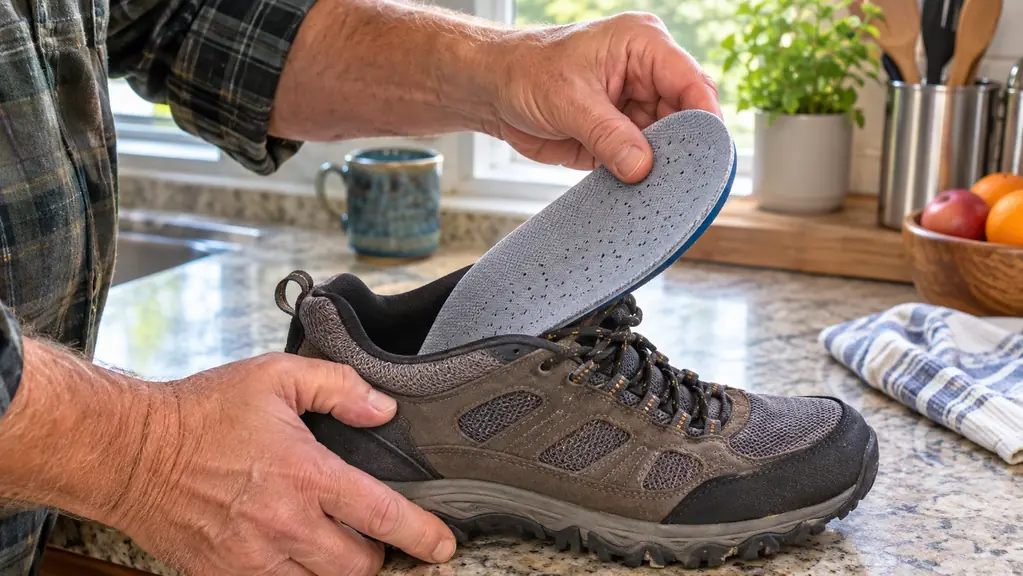
Gel is thin, and thin matters more than I expected. The foam footbed takes up real volume. The first week I had to loosen my laces by a hole and let the shoes give around the insole, and in one pair of walking shoes that are cut close, the foam never really fit. I gave up on that pair entirely and wore the other ones until they wore out. A gel pair slides in and the shoe feels the same from the outside. If your shoes are snug, or if you have a pair you love that will not take any extra bulk, that is a genuine advantage and I am not going to pretend otherwise.
Gel is also soft immediately. The Dr. Scholl's pair felt firm for the first two or three walks before it settled around my foot, and I spent those walks wondering whether I had wasted my money. A gel pair feels like a gel pair from the first step, which is satisfying in a way a slow break-in is not. It is also the thing you can find in a drugstore on a Saturday afternoon when you are leaving on a trip and your shoes suddenly feel like boards. There is something to be said for that. When a gel pair wears out you notice it all at once, in one walk, rather than the slow fade of foam that sneaks up on you over a month.
If your arches burn by mile two and your shoes have room in them, this is the pair I keep by the back door
Plush foam cushioning heel to toe, built-in arch support for low arches, women's 6 to 11 with a printed trim guide. About seven months in mine, replaced roughly twice a year.
Amazon Check Today's Price on Amazon →How I Compared Them
I walked in both, on the same routes, in the same season, which is the only fair way I know to compare anything. My routine is a paved trail around a lake near my house, mostly flat with one long downhill stretch, plus the concrete sidewalks in my neighborhood and the stairs in a two story house I climb more often than I would like. In winter the walks move to the mall or the treadmill in the basement. I wore the gel pair for six weeks in late winter, switched to the Dr. Scholl's pair in the spring, and have been in them ever since. Same socks, same time of morning, and the same shoes wherever the shoes would take both, because changing two things at once tells you nothing.
What I paid attention to was not comfort in the abstract. I counted how far I got before my arches complained. I noticed whether my knees felt worse the next morning, which is the number that actually matters to me, because a walk that costs me the following day is not a walk I can keep taking. I noticed whether my shoes still fit and whether I had to change my laces. And I noticed how long each pair lasted before the padding flattened and the shoe felt the way it did before I started. Four things, written on the back of an envelope, which is about as much bookkeeping as I am willing to do for a pair of insoles.
I did not do anything scientific. No force plates, no lab, no measuring devices. I also tried not to change three other things in the same week, which is the closest to a fair test a person can run in her own hallway. Before you take any of this as advice about your knees, run it past your doctor or your physical therapist. Mine were clear that walking is good for me and that a cushioned insole is a comfort measure, not a treatment.
The foam under the whole foot turned my last half mile from something I gritted through into an ordinary part of the walk.

What Seven Months of Mornings Taught Me
Foam compresses. That is not a flaw, it is what foam does, and the pair I am walking in now is my second. The first set started to feel thin under the ball of my foot somewhere around the six month mark, which lines up with how often I replace them. I did not notice it on one walk. I noticed it on a wet morning when the pavement was cold and hard and every step came through the shoe more than it had the week before. When I put the new pair in, the difference was obvious within a hundred steps, which tells me the old ones had been quietly giving up for a while before I noticed. I buy the women's 6 to 11, trim to the guide line, and they live in my walking shoes by the back door.
The bigger change is not in my feet, it is in how I plan my week. A couple of winters ago I was skipping walks because the sidewalk felt like a punishment. Now I put the shoes on, walk the loop, and come home and get on with the day. On mornings when my right knee is stiff, the insole is not what fixes it. The gel pack wrap used warm before I leave, or the compression sleeve on the right knee, does more for the stiffness than any insole will. What the insole does is keep the pavement from being the thing that ends the walk early.
Who Should Buy Which
Buy the Dr. Scholl's Walk Longer if you walk on pavement or concrete, if your arches are low and they tire before your legs do, and if your walking shoes have room in them. Buy the gel pair if your shoes are already snug, if you want a soft heel strike and nothing more, or if you want something you can drop in on the way out the door with no break-in period. If you have high arches, neither of these is really designed for you, and it is worth asking a podiatrist or the staff at a good running store before you spend anything.
One more thing worth saying plainly. An insole is a comfort measure. It is not going to change what is happening inside your knee joint, and if a pair of insoles is the only thing standing between you and a daily walk, that is worth a conversation with your doctor rather than a shopping trip. For me, the honest summary is that the Dr. Scholl's pair made the walk feel shorter than it is, and that was enough to get me back out the door most mornings.
Seven months in, they are still the pair by my back door
Foam cushioning heel to toe, arch support for low arches, women's 6 to 11 with a trim guide. Replace roughly every six months, or when the ball of your foot starts to feel the pavement again.
Amazon Check Today's Price on Amazon →