

I bought Dr. Scholl's Walk Longer insoles seven months ago, in March, out of plain frustration. My knees do fine on the crushed limestone loop at the nature center and they complain on the paved trail around the lake near my house, and it took me a shamefully long time to work out that the difference was not the hills. It was the ground. Concrete and asphalt send a jolt straight up through the heel, and by the time I reached my own driveway I was walking like a woman twice my age. I had already tried a compression sleeve and a good deal of rest. Neither one changed what the pavement did.
This is not a review that tells you these Dr. Scholl's insoles saved my knees. They did not, and I would not trust a review that said so about a piece of foam. What they did was smaller and more useful than that. They gave me back the last half mile on hard ground, the half mile I had quietly stopped walking without ever deciding to stop. I have now worn them through a Minnesota spring, a hot summer and the start of a wet fall, and I have replaced them once. Here is what I paid attention to, what surprised me, and the parts of the marketing I would ignore.
The Quick Verdict
Honest cushioning that makes pavement bearable again, for about four months at a time. Buy them for the foam, not for the 50% claim on the box, and expect to trim carefully and replace.
Amazon Check Today's Price →Pavement is what ends the walk. This softens it.
Plush foam with arch support, women's sizes 6 to 11, trimmed with ordinary scissors to fit the shoes you already walk in. Mine live in the walking shoes by the back door.
Amazon Check Today's Price on Amazon →What These Insoles Actually Are
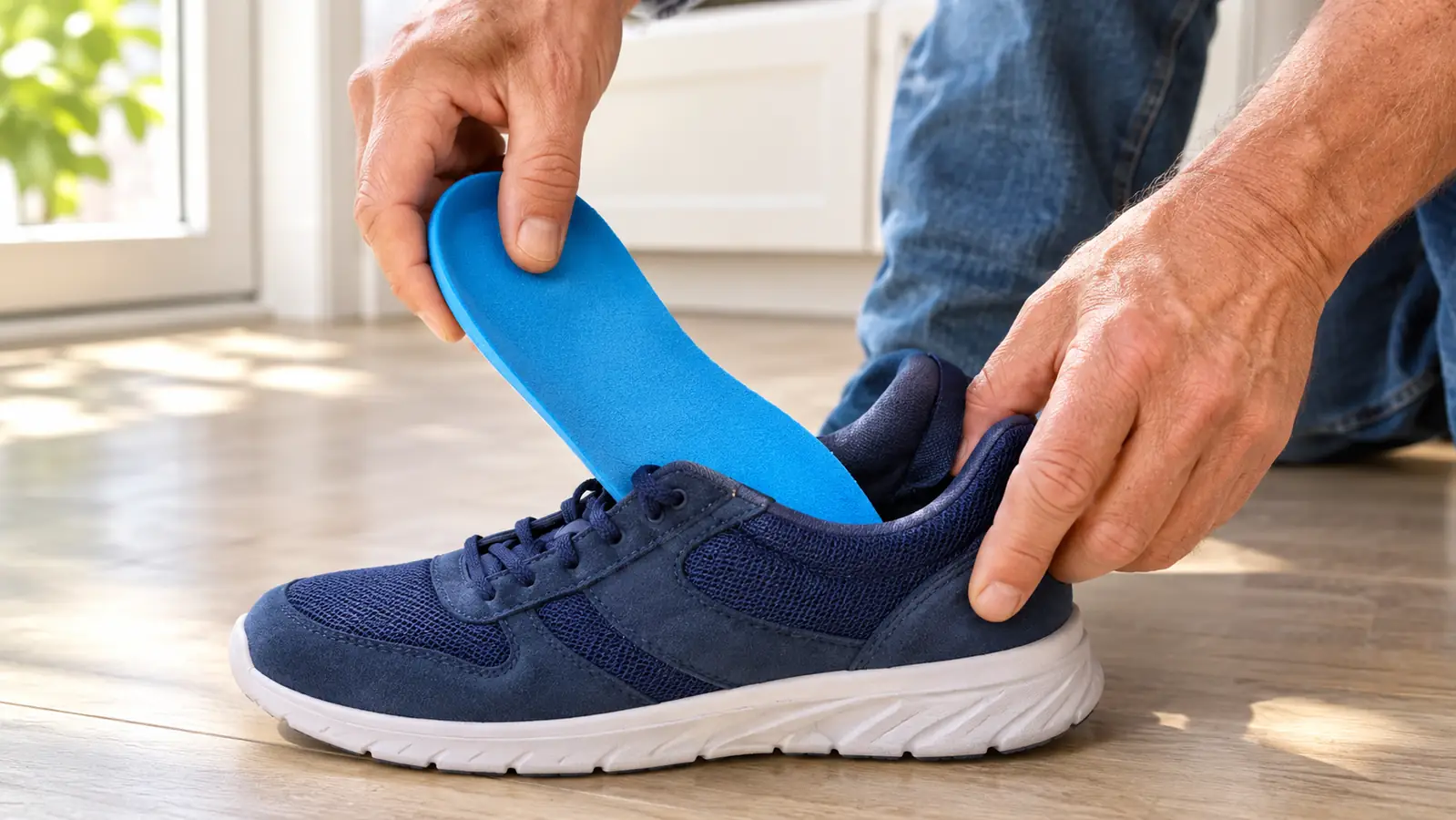
Strip the box away and this is a foam insert with an arch built into the midfoot, sold in women's sizes 6 to 11 and cut down with scissors to fit whatever shoe you put it in. The listing puts the item weight at 0.15 kg, calls the material foam, and describes the benefit as heel pain and cushioning. There is no rigid shell, no posted heel wedge, nothing you can hold by both ends and flex against your thumb. If you have ever pulled a stiff orthotic out of a shoe and felt how little it gives, this is the opposite of that. It is soft the whole way through, and the softness is the entire product.
The arch deserves a plain description, because the word support does a lot of quiet work on that box. What you get is a raised bed of foam under the middle of your foot, shaped for a low arch, which is what the listing says it is built for. On my feet that bump was strange for three or four days and then vanished from my awareness entirely. If you have a high arch and you are used to a firm orthotic holding you up, this Dr. Scholl's insert will feel like standing in damp sand by comparison, and you will probably dislike it from the first step.
It is also not a corrective device in the sense a doctor means when they fit you for one. It does not change how your foot lands, it does not retrain a muscle, and it does not do the work my physical therapist did over eight weeks. What it does is put a layer of foam between your heel and the ground, which is exactly what the name on the box promises and exactly what I needed. Nothing more than that, and I would rather say so than dress it up. The listing shows 4.4 stars across nearly five thousand ratings, which lines up with what I found: most people get comfortable, and most complaints are about wear.
How I've Used Them for Seven Months
I trimmed mine with ordinary kitchen scissors along the printed guide line, which took about two minutes and left a slightly wobbly edge that has never mattered. They went into my walking shoes, and those shoes live by the back door, so the insoles come out with them most mornings. My routine has not changed in seven months: the paved lake trail on good days, two to three miles depending on how the knees are behaving, and in winter either the mall loop with the other early walkers or the treadmill in the basement when the sidewalks are bad.
The distance is the part worth being honest about. Before my knees turned on me I was doing about four miles. Now a good day is two and a half to three and a bad day is a slow mile and a half with a bench in the middle. The insoles did not move that ceiling. What they changed is how much of the walk happens on hard ground before I start thinking about my knees instead of the water and the birds and whatever Gary is going on about at dinner. That is a smaller win than the box promises and a larger one than I expected.
I have replaced them once, at roughly the six month mark, because the foam under my heel had flattened to the point where I could feel the shoe underneath again. The listing gives no replacement interval, so that is my own rule of thumb and not a manufacturer instruction. Seven months in, the second pair is in the shoes and behaving exactly like the first one did in April, which is to say quietly. Nobody is going to notice you are wearing these, including you, which is the highest compliment I can pay an insole.
One practical note on shoes. I wear a roomy walking shoe with a removable factory insole, so these dropped in with space to spare. In a tighter shoe the extra layer was noticeable across the top of my foot until I loosened the laces a full pass and gave the foam a week to take the shape of my foot. If your everyday shoes are already snug across the instep, that is a real consideration before you order anything that goes inside them.
They did not fix my knees. They bought back the last half mile on pavement, which is the half mile I had quietly stopped walking.
The First Two Weeks, and the Trim I Got Wrong
The first trim was too aggressive. I cut straight to the line for my size, dropped them in, and found the insole ending a good half inch short of my toes, which left a ridge under the ball of my foot that I felt on every single step. The fix was a second pair and a slower approach: trim a little, put the insole in the shoe, stand on it, and take off another sliver only if the edge is curling up the side. Had I done that the first time I would still be on pair one and would have got my full six months out of it.
The first week was not comfortable the way I had pictured. The arch was noticeable, my shoes felt tight across the top, and by the end of a two mile walk I was aware of my feet in a way I am not normally. By day four or five the foam had taken the shape of my foot and the tightness was gone. If you put these in and dislike them on day one, loosen your laces, give it a week, and then decide. That advice is worth more than anything printed on the packaging.
Also worth knowing: these are a layer, not a replacement. If your shoes already have a thin factory insole glued down and it will not come out, the insoles will still fit, but the shoe will be snugger than it was. Mine lifted out easily. If yours are stuck, either wear the shoes looser for the first week or accept that the fit will be tight until the foam gives a little. Neither outcome is a disaster. It just helps to know which one you are walking into.
Where the Cushioning Stops Helping
Anything that is not a flat step is outside what foam can do. Stairs still cost me, going down especially. Getting up off the floor after stretching still takes a second and a hand on the couch. The long downhill stretch on the lake trail is still the worst four minutes of the walk, and no insole has ever touched that. I want to be clear about it, because this is where the honest version of this review lives. It helps with impact. It does nothing for the joint itself.
The other limit is time. Foam compresses whether you like it or not. Around four months I noticed I was thinking about my heels again on the concrete stretch, which is the same signal that sent me shopping in the first place. That is not a defect exactly, it is what the material does, but it means the real cost of these is not one purchase. If you walk daily the way I do, plan on a fresh pair roughly every six months. Buy them once and forget them and you will be disappointed by month five.
The claim on the box about walking fifty percent longer without muscle fatigue comes from the company's own testing, and I could not reproduce it. I kept a rough log for a month before and a month after, mostly because I am the sort of person who keeps a log. Before, I was good for about two miles on pavement before my heels started talking. After, I was good for two and a half, sometimes three, with less soreness at the end. That is a real improvement and I am not dismissing it. It is not fifty percent, though, and I would rather you hear that from me than from your own sore feet in October.
Which is the pattern with everything I have bought for these knees. The gain is real and it is partial. Nothing on the shelf at the drugstore is going to give you back the body you had at forty, and the sooner you make peace with that the less money you waste on the next thing. What you can do is stack small improvements: softer ground under the heel, warmth around the joint, a pole in each hand on the downhill, and the exercises the physical therapist gave you, done on the days you least feel like doing them.
What I Still Use Beside Them
The insoles are one piece of a routine, not the routine itself. I still wear a compression knee sleeve on my right knee for every morning walk and have for over a year. On a day with a lot of stairs I still use a cold pack for fifteen or twenty minutes afterward with a thin cloth between it and my skin. On the downhill stretch and on icy sidewalks in January I take the trekking poles. On achy days I use an over the counter gel as the label directs, after asking my doctor whether it was fine with everything else I take.
If I had to keep one thing and give up the rest, I would keep the sleeve, because the warmth and the snug feeling matter more to me than the cushioning does. But the Dr. Scholl's pair is the only item on that list that changed how the pavement itself felt under my heel, and that was the specific job I bought them for. None of this is medical advice. If your knees are new to hurting, see your doctor first, the way I did, before you spend anything on a shelf. That order matters more than any product I could name.
What I Liked
- Real foam cushioning that makes concrete and asphalt noticeably softer under the heel
- Trim to fit sizing covers women's 6 to 11, and the printed guide line makes it a two minute job
- Arch support built in for a low arch, noticeable at first and unremarkable after a week
- Light enough in the shoe that you forget they are there by the end of the block
- No real break-in drama beyond loosening the laces for the first few days
Where It Falls Short
- Foam flattens after about four months of daily walking, so the cost repeats
- Does nothing for stairs, downhills or getting up off the floor
- The 50% longer claim is not something I could reproduce on my own log
- Trim too fast and you will cut them short and feel a ridge under your toes
- Not firm enough for anyone used to a rigid orthotic holding them up
The Fit Questions I Get Asked
The question I hear most from friends who walk with me is whether a size 6 to 11 insole really covers a size 9 shoe. It does, because you are cutting it down, not hoping it matches. The printed guide line runs along the toe end and you scissor along it until the insole sits inside the shoe with no lip curling up the side. Mine took two passes to get right. If you are between sizes, trim to the larger line first and take more off only after you have stood on it in the actual shoe.
The second question is whether they work in shoes other than walking shoes. I have put mine in a pair of everyday loafers twice and took them out again both times, because the shoe was snug enough that the extra foam pushed my heel up and made the fit feel loose at the back. They belong in a shoe with room, which for most of us means the walking shoe. If you want cushioning for a dress shoe, this is not the product for that job, and I would rather say so plainly than sell you a second pair.
Who This Is For
This is for the walker whose knees are fine on grass and gravel and unhappy on pavement, and who would rather keep the morning loop than give it up. It suits a low arch, a roomy walking shoe, and someone willing to trim, test, and replace every few months without resenting it. It suits the person who has already seen their doctor, knows roughly what is going on in their knees, and is looking for comfort rather than correction. If that describes you, these are a sensible, inexpensive thing to try before you spend a great deal more on something custom made.
Who Should Skip It
Skip these if you need firm support under a high arch, if a podiatrist has fitted you with a posted orthotic and told you to wear it, or if your walking shoes are already tight across the top before you add anything. Skip them if you want one purchase that lasts years, because foam will not give you that no matter what the box implies. And skip them if you are hoping an insole will deal with stairs and getting up off the floor, because it will not, and you will end up blaming a decent product for a job it never claimed.
Soft ground under your heel, for the half mile you stopped walking
Plush foam with arch support, women's sizes 6 to 11, trimmed with scissors to fit your own shoes. Mine are in the walking shoes by the back door, seven months in.
Amazon Check Today's Price on Amazon →